- contact@insightcontractsai.com
AI agents
Agents that prepare the matter, and lawyers who decide it
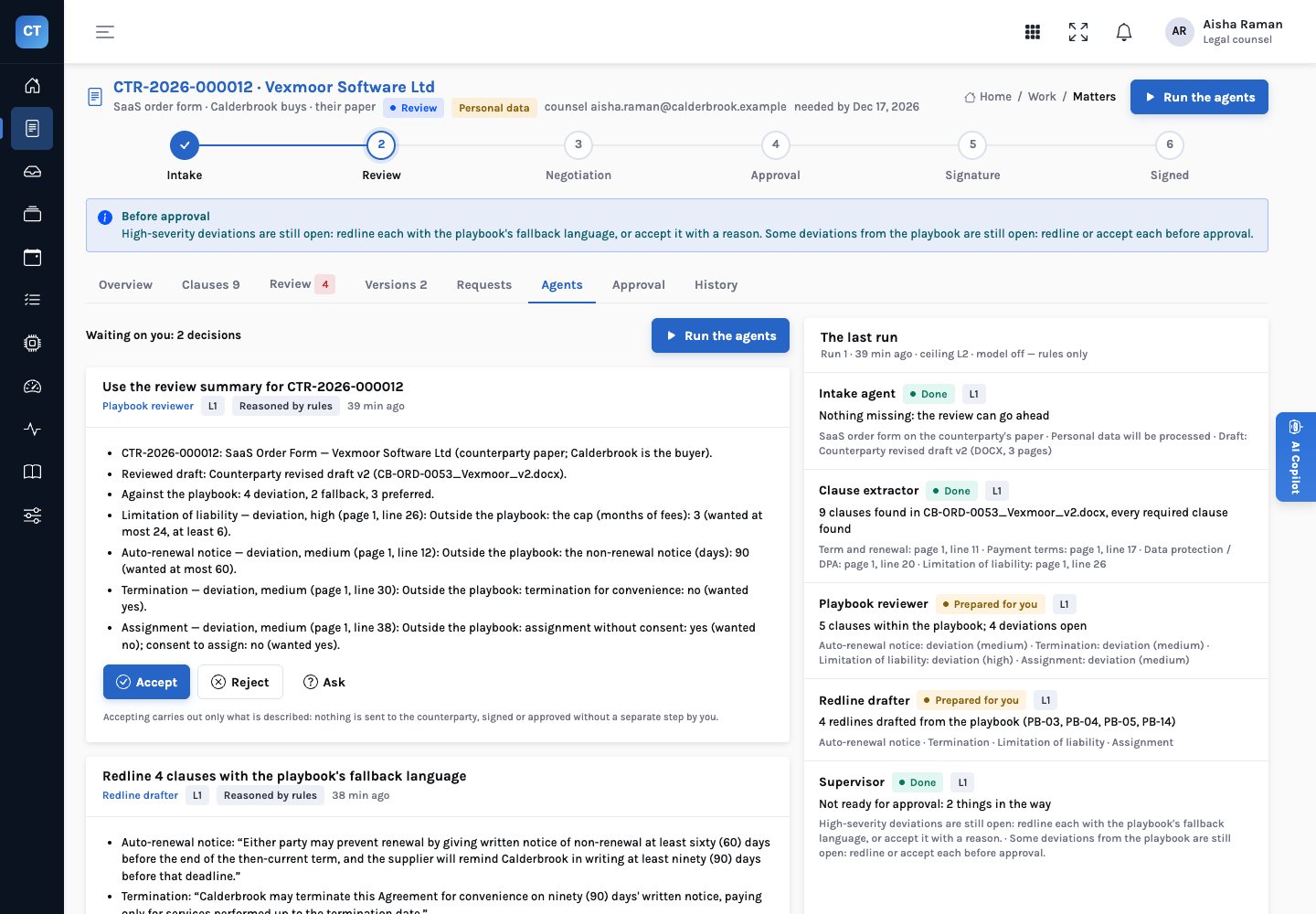
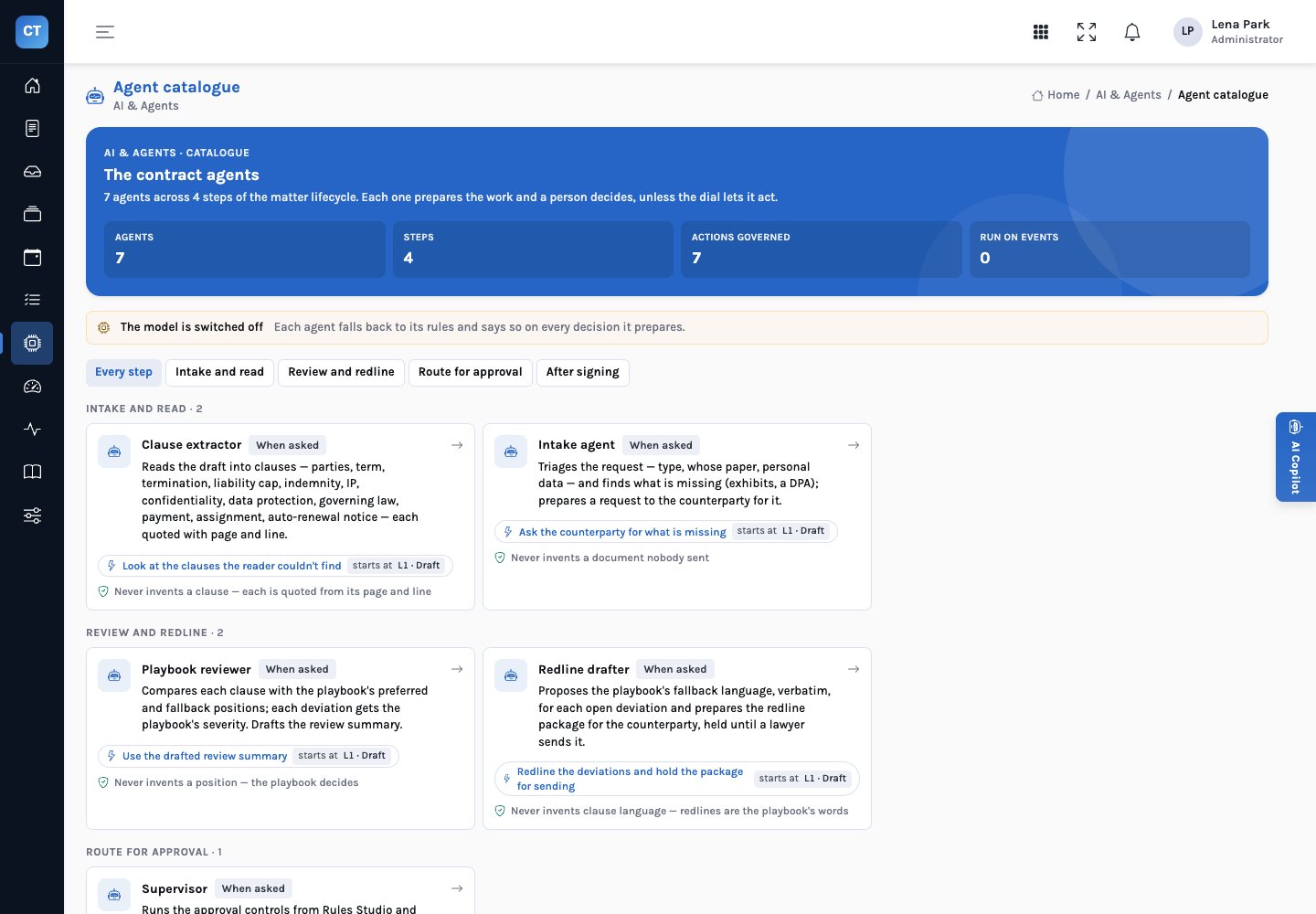
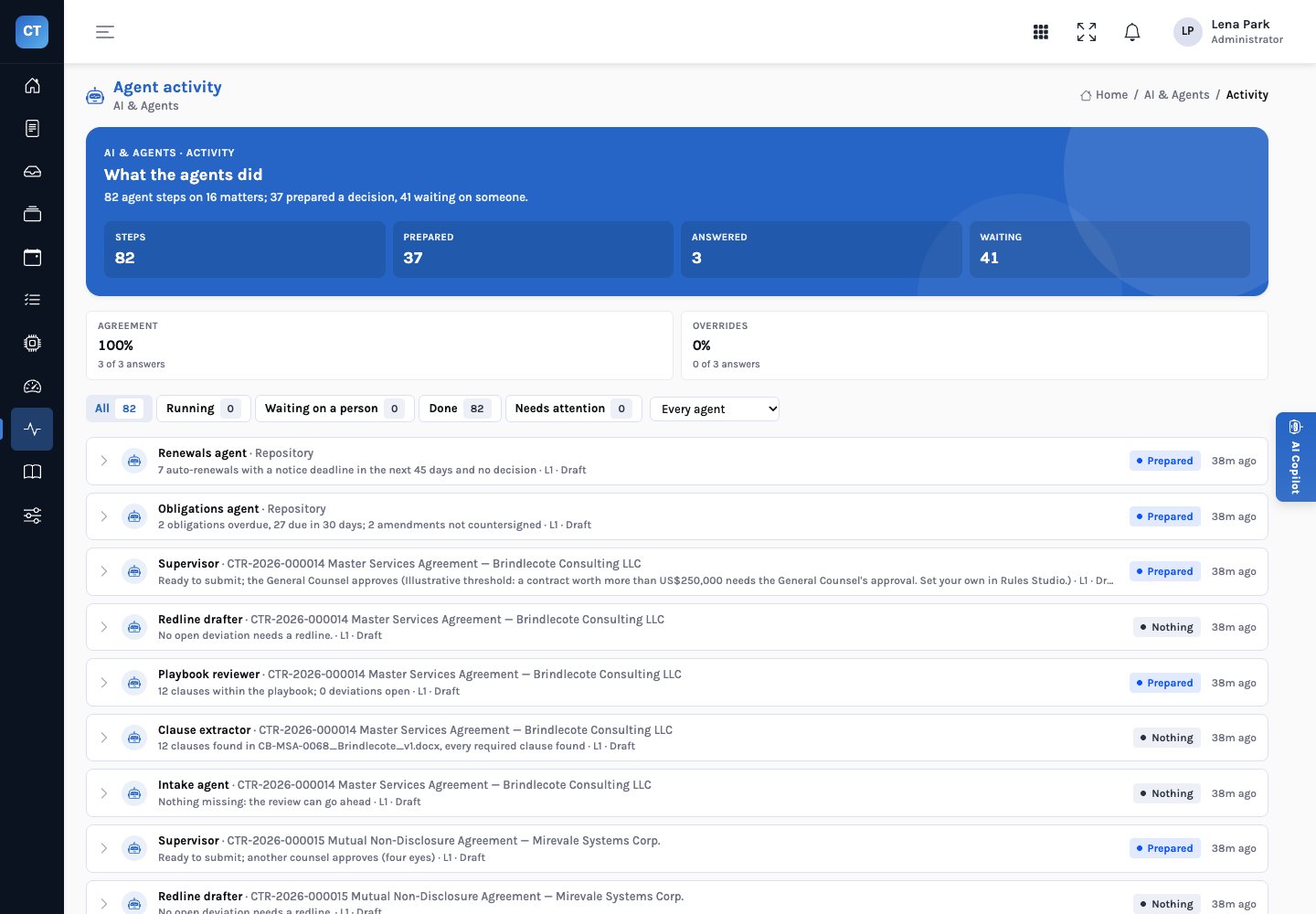
Seven agents, one per stage. They triage, read, compare, assemble redlines and watch deadlines. They don’t send, sign, accept deviations or approve.
The seven agents
One stage each, and a line none of them crosses
Every agent writes what it found and why. When a person needs to act, the agent prepares the decision and waits. Accepting a deviation, sending to a counterparty, approving a matter and recording a signature are refused to an agent in the code, whatever its level.
| Agent | Stage | What it prepares | What it never does |
|---|---|---|---|
| Intake agent | Intake and read | The contract type, whose paper, personal data, and what is missing; a request to the counterparty for it | Send the request, or invent a document nobody sent |
| Clause extractor | Intake and read | Which clauses the reader found, each with page and line, and the required ones it couldn’t find | Invent a clause: each is quoted from its page and line |
| Playbook reviewer | Review and redline | The position of every clause and the review summary for the counsel to use | Decide a position: the playbook decides |
| Redline drafter | Review and redline | The playbook’s fallback language for each open deviation, and the redline package, held | Write clause language of its own, or send the package |
| Supervisor | Route for approval | What the approval controls say, and the submission, to the General Counsel where referred | Approve: people approve |
| Obligations agent | After signing | What is overdue or due soon, requests to counterparties for what they owe, reminders for owners | Mark an obligation done, or invent one |
| Renewals agent | After signing | Auto-renewals whose notice deadline is close, and a renewal review before the window shuts | Decide to renew or terminate, or invent a deadline |
Autonomy
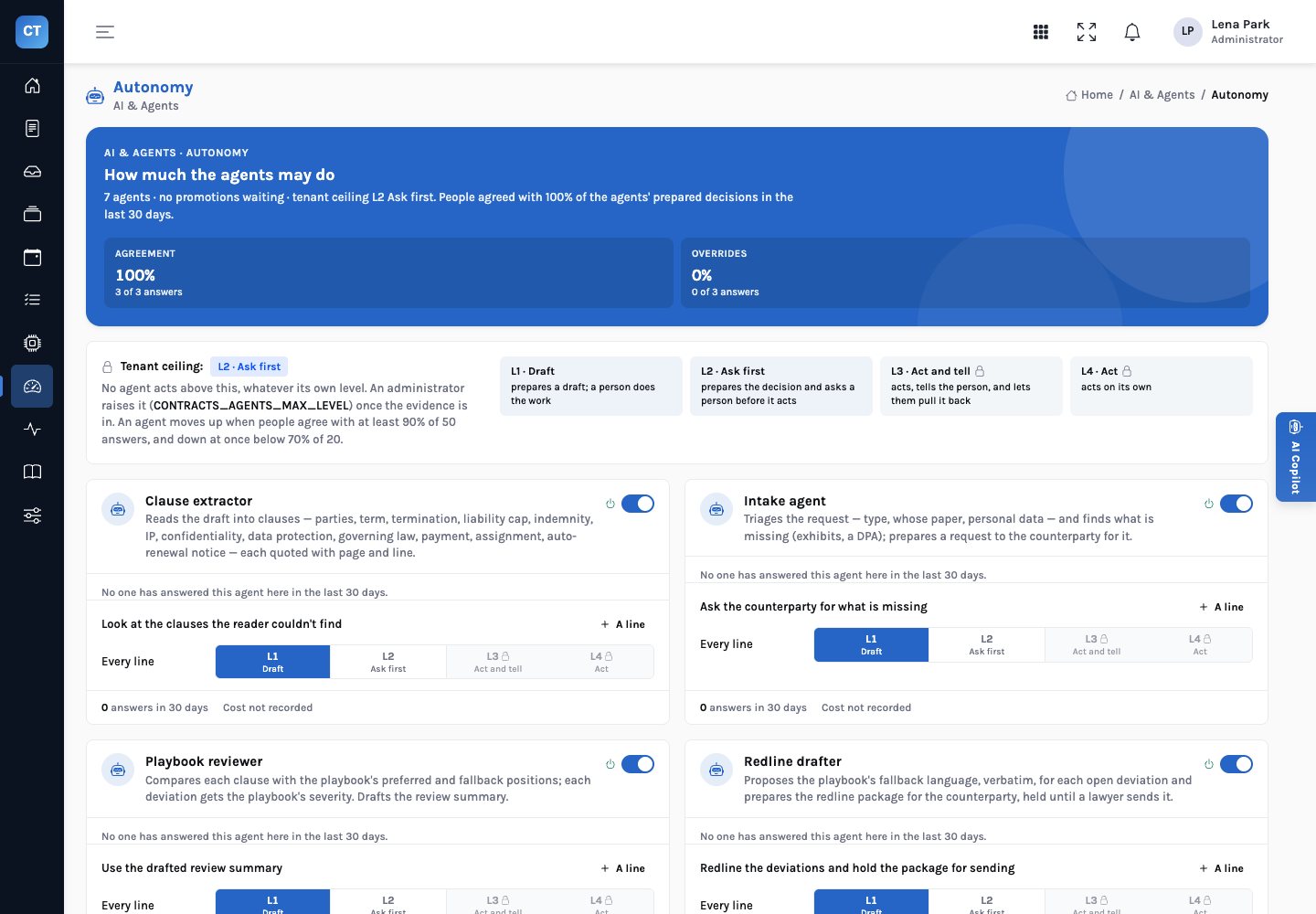
Autonomy is earned, one level at a time
Each agent starts at L1 for each action. An administrator can raise it, up to the tenant ceiling of L2 (Ask first), set by CONTRACTS_AGENTS_MAX_LEVEL and capped again in code. A promotion is recommended only once people agreed with at least 90% of 50 or more answers over thirty days, and a manager accepts it; an agent drops back at once if agreement falls below 70% over 20 or more.
| Level | Name | What the agent may do |
|---|---|---|
| L1 | Draft | Prepares a draft; a person does the work |
| L2 | Ask first | Prepares the decision and asks a person before it acts. The ceiling for every InsightContracts agent |
| L3 | Act and tell | Acts, tells the person and lets them pull it back. Locked |
| L4 | Act | Acts on its own. Locked |
Grounding
The model explains. It never supplies the clause.
Reading, the playbook comparison, the cross-document checks, the controls and the deadlines are deterministic code. Where a language model is used, it phrases what an agent found over numbered facts; a sentence carrying a name or number that isn’t in the facts is thrown away and the engine’s own wording stands.
Deterministic
The engines decide positions
Clauses, positions, severities, controls and notice deadlines are calculated, not generated.
Verbatim
Redlines are the playbook’s words
No model writes clause language. The suggested redline is your fallback text, copied exactly.
Fallback
Model off is a supported mode
With the model switched off, every agent runs on its rules and says so on each step.
Prepared decisions
Accept, reject or ask
What an agent prepares lands on the matter and on the counsel’s home. Accepting carries out only what is described; rejecting records that a person disagreed; asking sends a question back. Each answer is kept and counts toward the agent’s agreement rate.