A services agreement can be perfectly drafted on price, term and liability and still leave the company exposed, because the supplier will handle personal data and the contract never says how. Data protection law in many jurisdictions expects that relationship to be governed by a written contract with specific terms. In practice that contract is usually a data processing addendum, and the commonest failure is not a bad DPA but no DPA at all.
In short
- Under the GDPR, a controller may only use processors under a binding contract. Article 28(3) lists what that contract must contain; Article 28(9) says it must be in writing, which includes electronic form.
- US state privacy laws have their own contract requirements. California’s, for example, sets terms for contracts with service providers and contractors. The details differ by state; the habit of checking for the contract is the same.
- The gap is usually cross-document. The services agreement mentions personal data; the DPA is supposed to be an exhibit, or signed under the master agreement, and isn’t.
- A review can check the whole contract family. InsightContracts looks for a DPA attached, on the matter, or signed under the parent agreement, and blocks approval when none is there.
Why a contract is required at all
The EU General Data Protection Regulation (and the UK GDPR, which follows it closely on this point) distinguishes the controller, which decides why and how personal data is processed, from the processor, which processes it on the controller’s behalf. A company that hires a payroll provider, a cloud analytics vendor or a staffing agency with access to employee records is usually the controller, and the supplier a processor.
Article 28 puts two duties on the controller. It may use only processors that provide sufficient guarantees to implement appropriate technical and organisational measures (Article 28(1)). And the processing must be governed by a contract or other legal act that is binding on the processor and sets out the subject-matter, duration, nature and purpose of the processing, the types of personal data, the categories of data subjects, and the controller’s obligations and rights (Article 28(3)).
What Article 28(3) says the contract must contain
| Article 28(3) | The processor must… |
|---|---|
| (a) | process the personal data only on the controller’s documented instructions, including on transfers to third countries, unless law requires otherwise |
| (b) | ensure that people authorised to process the data are bound by confidentiality |
| (c) | take the security measures required by Article 32 |
| (d) | respect the conditions for engaging another processor (sub-processors), set out in Article 28(2) and (4) |
| (e) | assist the controller, by appropriate measures, in responding to requests from data subjects exercising their rights |
| (f) | assist the controller with its obligations under Articles 32 to 36: security, breach notification, data protection impact assessments and prior consultation |
| (g) | delete or return all personal data at the end of the services, at the controller’s choice |
| (h) | make available the information needed to demonstrate compliance, and allow for and contribute to audits and inspections |
A single sentence in a services agreement promising to “comply with all applicable data protection laws” covers none of this specifically. That is why most companies use a separate addendum in a standard form and treat its absence as a stop.
United States
US state comprehensive privacy laws take a similar approach for their own terms. California’s law, as amended by the CPRA, requires a contract with each service provider or contractor containing specified terms, such as limiting use of the personal information to the business purposes in the contract. Other states with comprehensive privacy laws have comparable processor-contract provisions. The exact terms vary by state and change; check them with counsel for the states you operate in.
Where the gap hides
Very few draft agreements are missing a DPA because someone decided to skip it. The gap appears at the joins between documents:
- the agreement says the DPA is “attached as Exhibit C”, and Exhibit C isn’t in the file;
- a statement of work brings personal data into scope under a master agreement whose DPA was never signed;
- the counterparty’s paper has only a general promise to comply with data protection law;
- the business request said “no personal data” and the services description says otherwise.
Each of these needs a reader to hold several documents at once. That is easy to forget on the fourth agreement of the day.
The cross-document check InsightContracts runs on every draft where personal data is processed.
How InsightContracts checks it
Each matter records whether the counterparty will process personal data, from the business’s intake request. When it will, and the contract is a master services agreement, statement of work, SaaS order form or supply agreement, the playbook review looks for a DPA in three places: attached to the draft as an exhibit titled as a data processing addendum, filed on the matter as its own document, or signed under the parent agreement. If none is there, the review raises a single high-severity finding — personal data without a DPA — and folds in what the draft’s own data protection clause says, or that it has none.
Separately, the data protection clause itself is compared with the playbook position. In the illustrative demo playbook, the preferred language has the supplier process personal data only on the company’s documented instructions and under a signed DPA; the fallback requires a DPA in the company’s standard form, signed before any personal data is shared. A clause that is only a general promise to comply with the law is flagged as such.
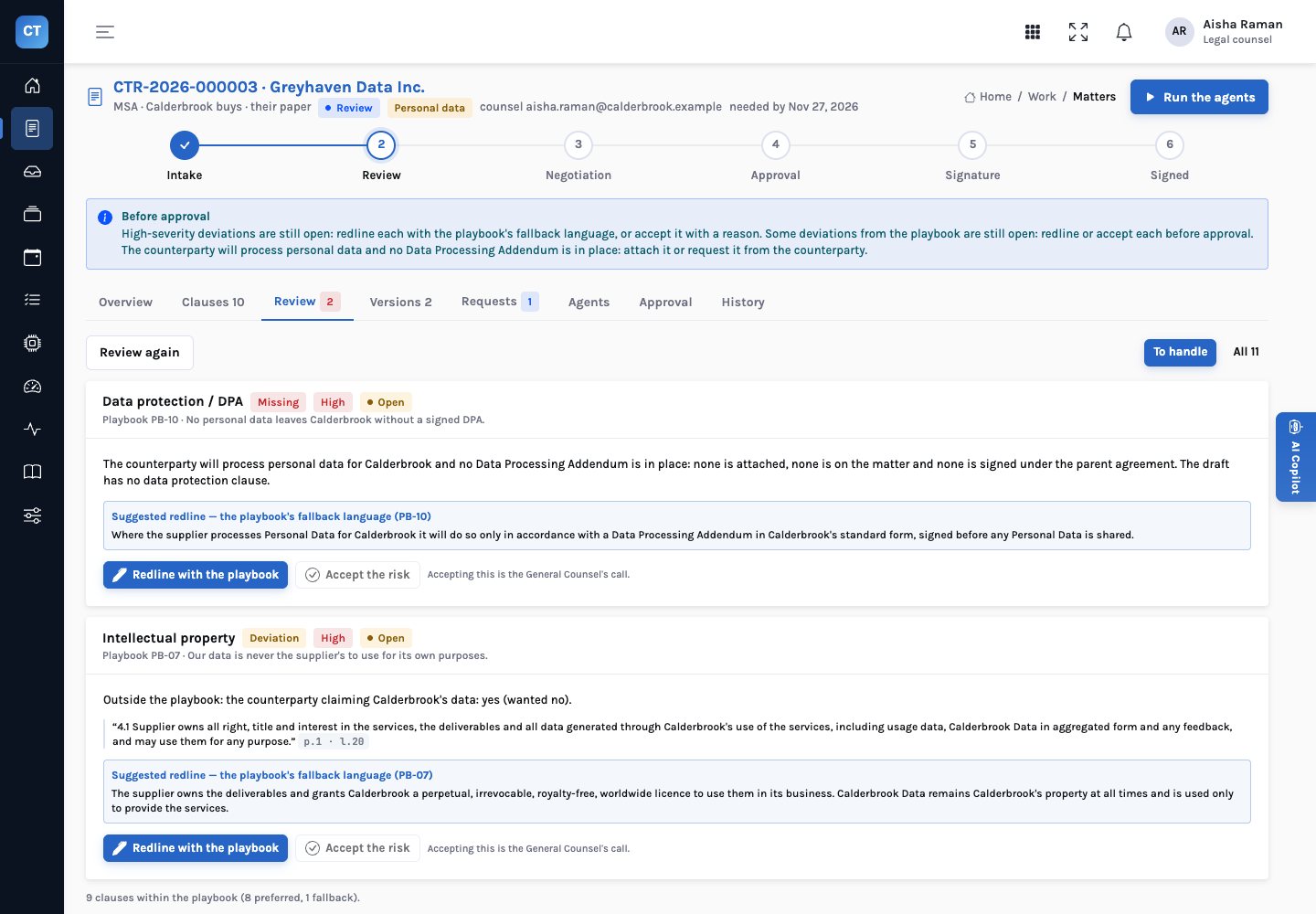
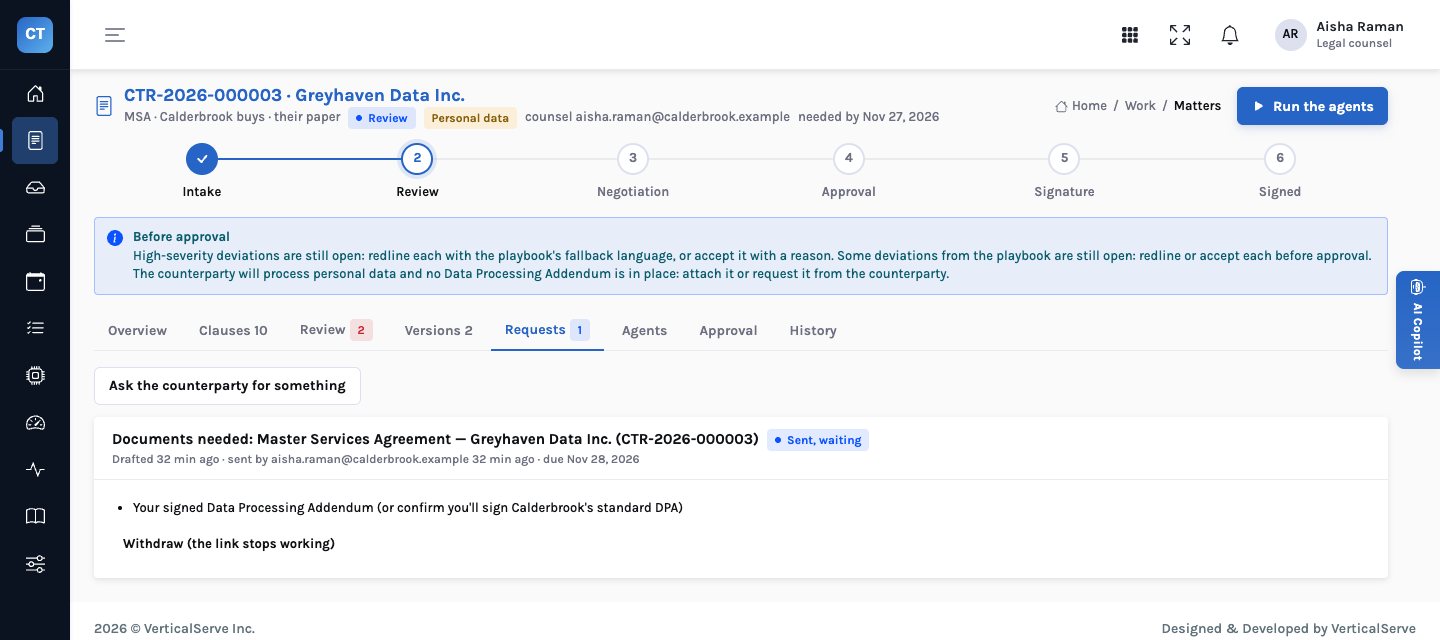
The approval control “Personal data without a DPA” blocks the matter until the finding is resolved. There is no fallback text to redline with, because the fix is a document, not a sentence, so the intake agent prepares a request to the counterparty for the signed DPA. The request is held until a lawyer sends it; when the counterparty uploads the DPA through the request link, it is filed on the matter and the review runs again.
The intake request says whether the supplier will process personal data.
Exhibit, matter, parent: no DPA in any of them. One high-severity finding.
“Your signed Data Processing Addendum (or confirm you’ll sign Calderbrook’s standard DPA)”, held for review.
Nothing reaches the counterparty until a person releases it.
Uploaded through a link with no login, filed on the matter, review re-run.
With the DPA on the matter, the block lifts; the remaining findings decide what happens next.
For the General Counsel
A contract with a processor that lacks the required terms is a compliance gap for the company as controller, whatever the commercial terms say. A rule that blocks approval makes the check unconditional.
The decision record shows the DPA finding and how it was resolved, for each contract.
For legal operations
The DPA request is drafted the moment the gap is found, so the counterparty is asked once, early, rather than at signature.
For the board
Which suppliers process the company’s personal data without a signed DPA is a question the repository can answer, contract by contract.
Not legal advice
This post summarises Article 28 of the GDPR and mentions US state law only in general terms. Whether a supplier is a processor, which laws apply and what your DPA must say are questions for your own counsel. InsightContracts checks that a DPA is in place; it does not assess whether its terms are sufficient.
The most common DPA problem is not a weak clause. It is a missing document.
Check the whole contract family — the exhibit, the matter, the parent — every time personal data is involved, and make the absence of a DPA something approval cannot get past.