Ask an in-house lawyer where the week went and the answer is rarely “the hard clause”. It is the fourth NDA on the counterparty’s paper, the order form that refers to an exhibit nobody sent, the revised draft that has to be read again from the top to find the three words that changed. The judgement in a contract review takes minutes. The preparation around it takes the day, and it grows with every contract the business signs.
In short
- Review time is mostly preparation. Finding each clause, comparing it with the company’s position, checking the exhibits and the parent agreement, and re-reading revised drafts come before any judgement.
- Preparation scales with volume; judgement scales with risk. Adding lawyers to a queue of routine paper buys capacity at the price of the most expensive hour in the company.
- The fix is to prepare the matter, not to skip the lawyer. Read the draft into clauses with page and line, compare each with a written playbook, and put the open questions in front of the person who decides.
- After signing, the work changes shape. Notice deadlines and obligations are dates buried in executed copies; nobody reads a signed contract again until something goes wrong.
Where a review actually goes
Take a typical request from the business: a master services agreement with a new supplier, on the supplier’s paper. Before a lawyer can say anything useful, someone has to establish what kind of contract it is, whose paper, whether the supplier will handle personal data, and whether everything the draft refers to is actually attached. Then the clauses have to be found — liability is in section 8 in one template and section 11 in another — and each has to be held up against what the company normally accepts.
| Step | What it involves | Judgement or preparation? |
|---|---|---|
| Triage | Type of contract, whose paper, personal data, value, who asked and by when | Preparation |
| Finding the clauses | Term, renewal, termination, liability, indemnity, IP, confidentiality, data protection, governing law, payment, assignment | Preparation |
| Comparing with the company’s positions | Preferred, acceptable fallback, or outside both | Mostly preparation |
| Cross-document checks | Exhibits referenced but missing; a DPA where personal data is processed; the parent agreement’s terms | Preparation |
| Drafting the changes | Proposed language for each deviation | Preparation, if the language already exists |
| Deciding what to accept | Which risks the company takes, and who may take them | Judgement |
| Re-reading the next draft | What changed, and whether the changes were taken | Preparation |
| Approval | The right person signs off, on the right evidence | Judgement |
Most of the rows are preparation. They are necessary, they need care, and they are the same every time. The two judgement rows — what the company accepts and who approves — are where a lawyer’s training earns its cost.
Why adding people doesn’t fix it
A legal team under pressure usually responds in one of three ways: hire, push routine paper back to the business with a template, or send overflow to outside counsel. Each helps for a while.
- Hiring adds capacity in proportion to headcount, but each new lawyer spends most of the day on the preparation rows above. The ratio of preparation to judgement doesn’t change.
- Self-service templates work for the company’s own paper. They do nothing for the counterparty’s paper, which is where the deviations are.
- Outside counsel buys hours, not consistency. Two firms, or two associates, will read the same limitation-of-liability clause against slightly different ideas of what the client accepts, unless those ideas are written down.
A lawyer finds each clause by hand, compares it with positions held in memory or a PDF, checks exhibits when they remember to, and re-reads the next draft in full to see what moved.
Each clause is found and quoted with its page and line, compared with written positions, and cross-checked against exhibits, DPAs and the parent agreement. The lawyer starts from the open questions.
Three things that go wrong quietly
The cost of a slow review is visible: the business waits. The more expensive failures are the ones nobody notices until later.
The clause that drifted
A counterparty’s revised draft fixes the three points you raised and changes a fourth you didn’t. If the second draft is read for the requested changes only, the fourth goes through. Comparing drafts clause by clause, with the playbook position before and after, makes the drift visible.
The document that wasn’t there
An agreement refers to “Exhibit B (Insurance Requirements)” and the exhibit is missing; a services agreement has the supplier processing personal data and no data processing addendum anywhere in the contract family; an order form’s assignment clause contradicts the master agreement it sits under. Each is a cross-document check that a careful lawyer performs and a busy one skips.
The date after signing
An auto-renewal with a ninety-day notice period can only be stopped three months before the end of the term. A supplier’s annual security report is due thirty days after each anniversary. These dates live in executed copies that nobody re-reads.
Preparation (light) surrounds two decisions (tinted). The same matter continues after signing.
What a prepared matter looks like
InsightContracts treats each contract as a matter that moves through intake, review, negotiation, approval, signature and signed. When a draft arrives, a reader turns it into twelve clause types — parties, term and renewal, the auto-renewal notice, termination, limitation of liability, indemnity, intellectual property, confidentiality, data protection, governing law, payment terms and assignment — each quoted with its page and line. The reader is deterministic: it finds clauses from the document’s structure and wording, and a clause it can’t find is reported missing rather than guessed.
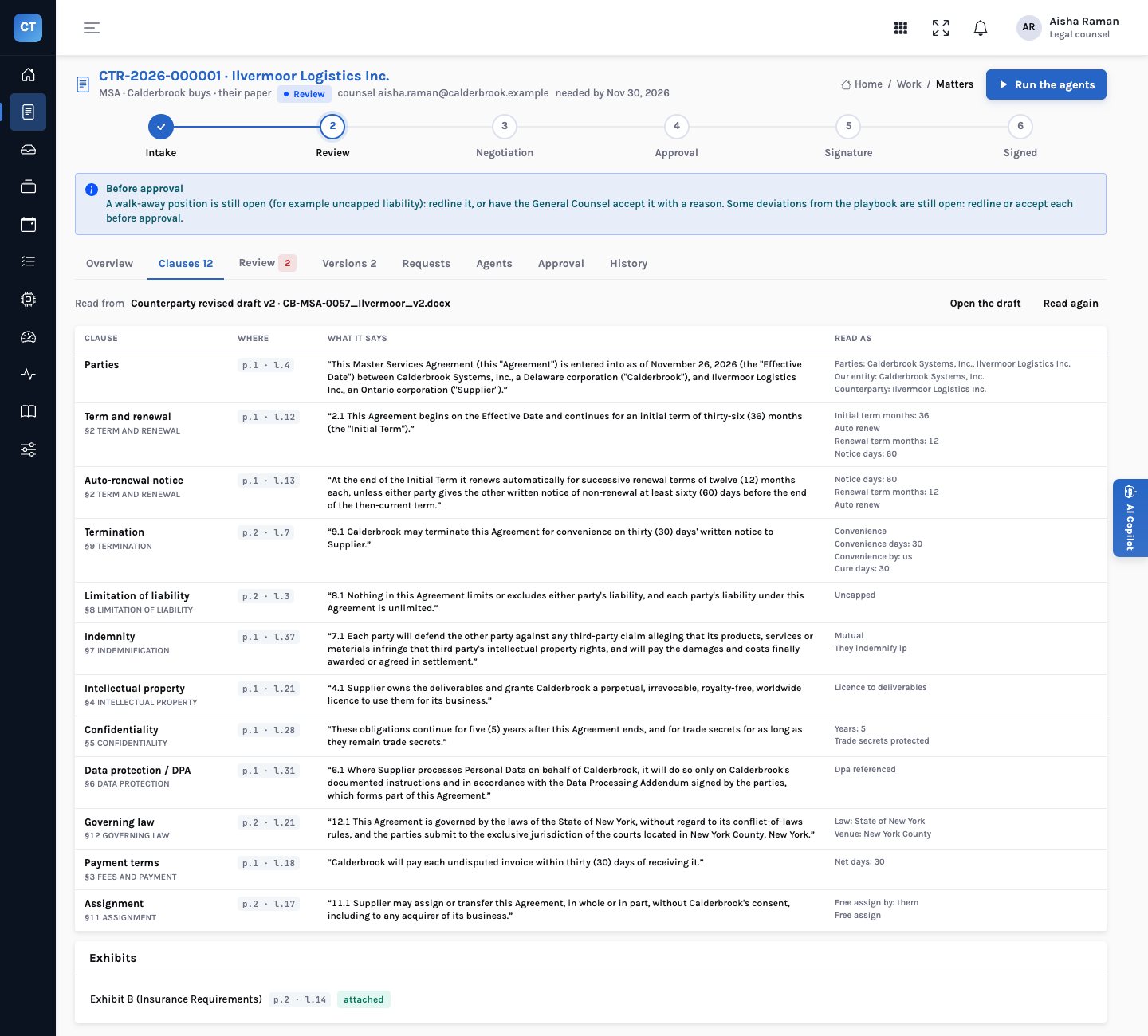
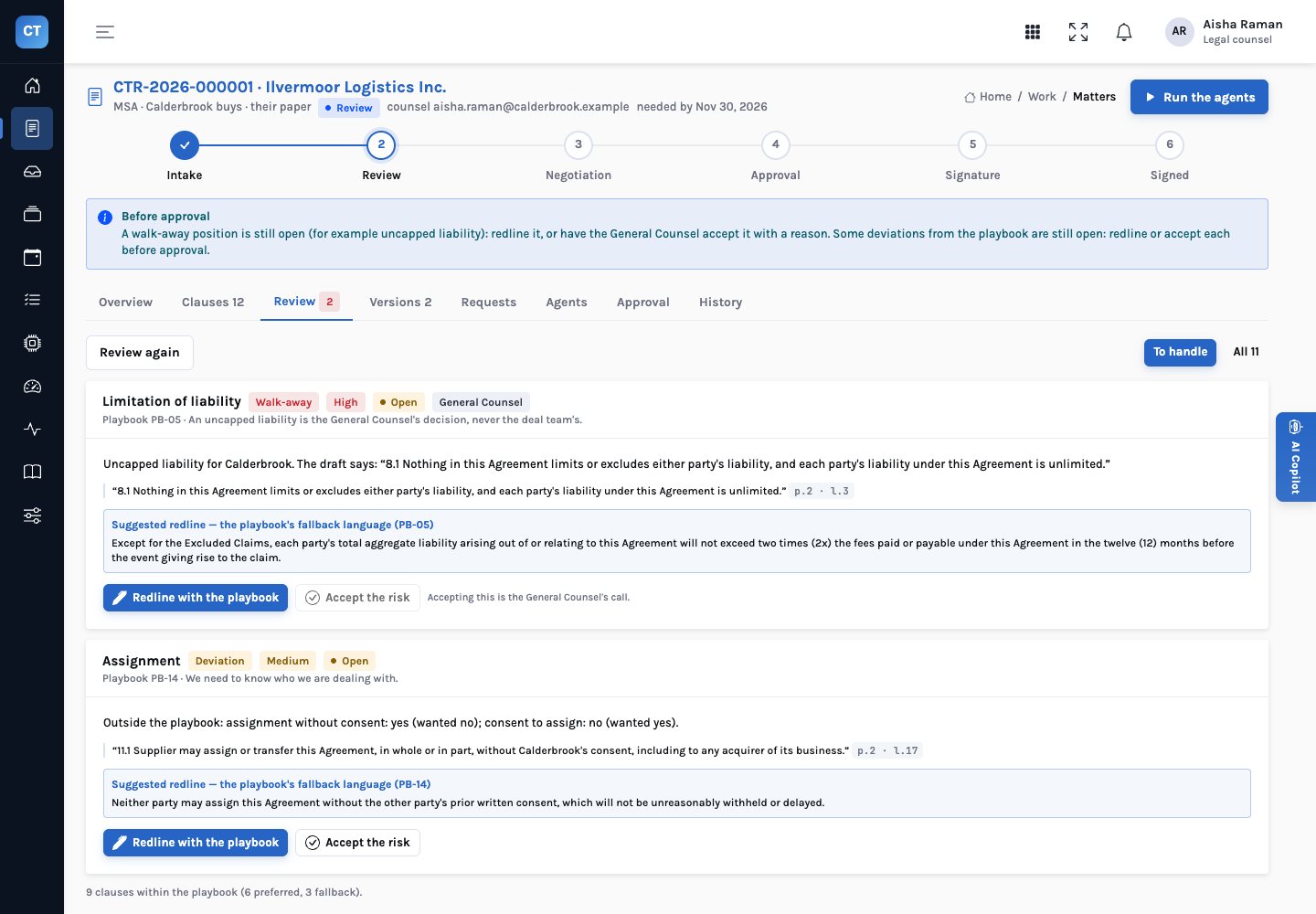
Each clause is then compared with the company’s playbook: preferred, within the fallback, outside the playbook (a deviation with the playbook’s own severity), a walk-away position, or missing. Cross-document checks add what a clause-by-clause comparison can’t see: personal data with no DPA, an assignment clause that conflicts with the parent agreement, exhibits referenced but not attached. The lawyer opens the matter to a short list of what needs a decision, with the suggested redline for each — the playbook’s fallback language, word for word.
What it means at each level
For the General Counsel
The positions the team negotiates from become explicit and consistent, and the decisions reserved to you — uncapped liability, foreign governing law, high-value contracts — reach you by rule rather than by habit.
Every approval keeps what the controls said and how each clause was resolved, which is the record you need when a contract is questioned later.
For legal operations
Routine paper stops consuming senior time. The queue shows what is blocked, what waits on the counterparty and what is ready for approval.
Renewal notice deadlines and obligations come out of the executed copies into a calendar and a tracker with owners.
For the board
The legal team’s capacity is spent on judgement, and the company’s contractual risk is visible: which contracts carry uncapped liability, which renew automatically and when, what is overdue.
What this is not
Nothing here replaces a lawyer. The reader finds clauses; the playbook says what the company prefers; a person decides what to accept, what to send and what to approve. InsightContracts doesn’t give legal advice, and its demo playbook is illustrative.
The judgement in a contract review takes minutes. Make the preparation take minutes too.
Reading, comparing and cross-checking are the same work on every draft. Do them once, consistently, with the page and line on every finding, and the lawyer’s time goes where only a lawyer can help.