- contact@insightcontractsai.com
InsightContracts · contract review, prepared by agents
Every contract reviewed against your playbook. Every call your lawyers’.
InsightContracts reads the counterparty’s draft, PDF or Word, into its clauses and quotes each one with its page and line. It compares every clause with your playbook’s preferred and fallback positions, finds the missing DPA, the exhibit nobody attached and the assignment clause that contradicts the master agreement, and proposes the playbook’s own fallback language as the redline. Then it stops, and a lawyer decides.
- Every clause quoted with page and line
- Redlines in your playbook’s words
- Lawyers decide, on the record
What a matter is built from
NDAsMaster services agreementsStatements of workSaaS order forms
Supply agreementsLeasesData processing addendaAmendments & exhibits
PDF and Word draftsYour intake requestsYour playbookYour contract register
The problem
Legal teams don’t lack positions. They lack time to apply them to every draft.
Most of a contract review is preparation: finding the liability clause in someone else’s numbering, checking it against the playbook, noticing that the DPA the agreement mentions isn’t attached, and retyping the company’s fallback wording into a redline. The judgement, which is the part only a lawyer can do, gets whatever time is left. And after signing, the notice deadline and the supplier’s annual report live in a PDF nobody reopens.
Preparation
The reading before the decision
Every draft read from the top, every clause compared with a playbook that lives in a separate document, every revised draft compared by eye with the last one.
Gaps
What isn’t in the draft
A services agreement where the supplier will handle personal data and no Data Processing Addendum exists anywhere. An exhibit referenced on page 2 and never attached. A clause that quietly overrides its master agreement.
After signing
“It renewed? When was the deadline?”
An auto-renewal can only be stopped before its notice deadline, often months before the end date. Missing it buys another term. So does forgetting the certificate the supplier owes every year.
How it works
Intake → Read → Review → Negotiate → Approve → Track
One matter for every contract request. Seven agents prepare each stage. A lawyer accepts, rejects or asks about what they prepared, and makes every decision that matters.
1
Intake and read
A matter opens from the business’s request or an uploaded draft. The reader finds twelve clause types, each quoted with its page and line, plus the exhibits referenced and attached and the signature blocks.
2
Review
Each clause is compared with the playbook: preferred, fallback, deviation, walk-away or missing. Cross-document checks catch a missing DPA, a missing exhibit and an assignment clause that conflicts with the parent.
3
Negotiate
A redline is the playbook’s fallback language, verbatim, held until a lawyer sends it. Each new draft is read, reviewed and compared with the last, clause by clause and word by word.
4
Approve
Ten approval controls in Rules Studio block or refer the matter to the General Counsel. The approver is never the submitter, and the decision record keeps every control’s outcome.
5
Track
The executed copy joins the repository. Obligations are tracked with an owner and a due date, and every auto-renewal’s notice deadline is on the renewals calendar.
A real matter from the demo
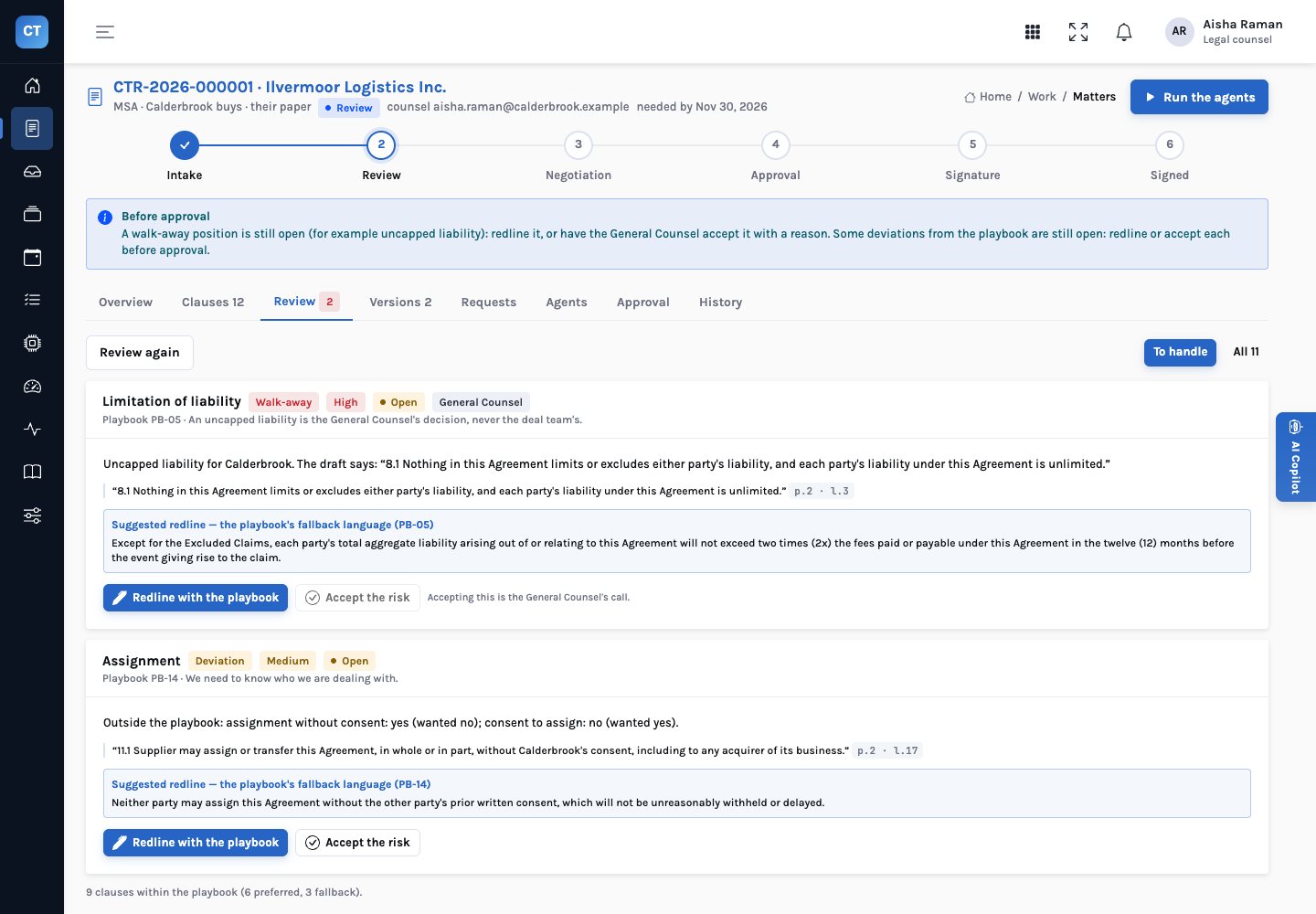
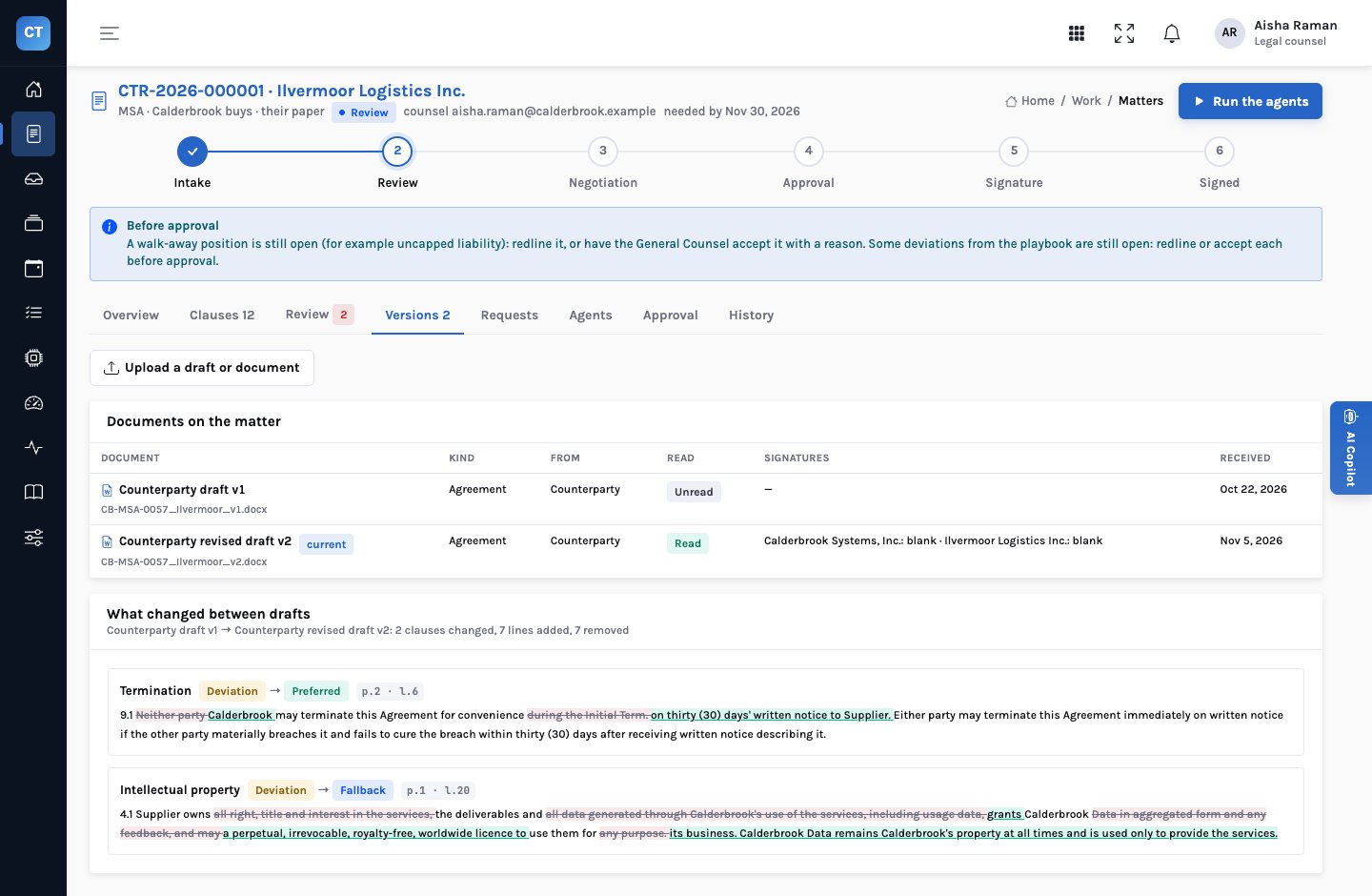
The revised draft fixed termination and IP. Liability was still unlimited.
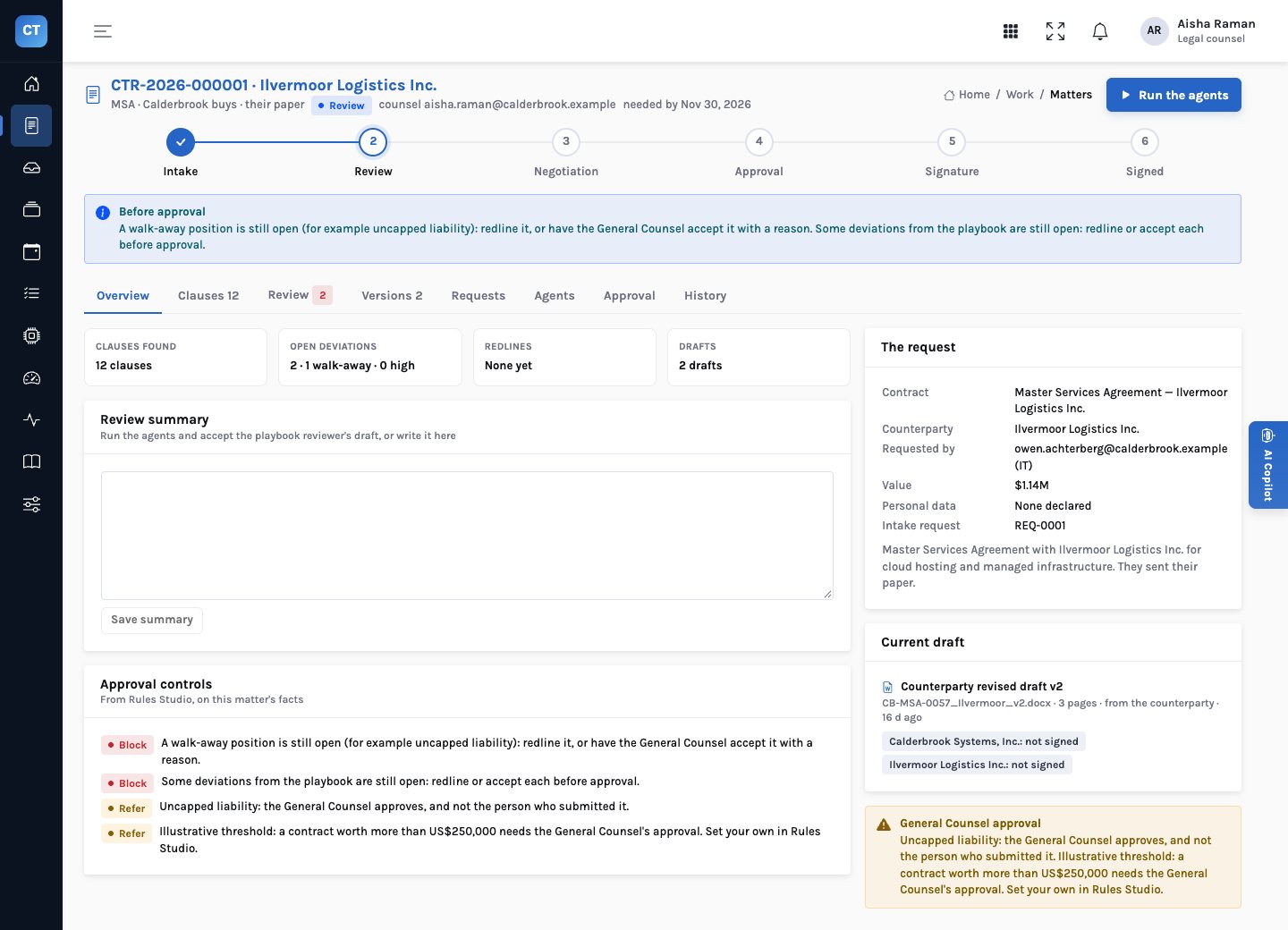
From the fictional demo company, Calderbrook Systems, Inc.: a US$1.14 million master services agreement on the supplier’s paper, matter CTR-2026-000001 with Ilvermoor Logistics Inc. The supplier’s second draft moved on two clauses. The comparison shows what moved, and the review shows what didn’t.
Draft v1 → v22 clauses changedtermination: deviation → preferred; IP: deviation → fallback
Page 2, line 3“each party’s liability … is unlimited”walk-away position PB-05, high, the General Counsel’s
Suggested redlineThe playbook’s fallback, verbatima cap of two times the fees in the twelve months before the claim
Approval2 controls block, 2 referto the General Counsel: uncapped liability, and value over the illustrative US$250,000
The playbook and the US$250,000 threshold in the demo are illustrative, not legal advice. The matter, worked end to end
What the review finds
The deviations, and the things that aren’t there at all
Clause-by-clause comparison with the playbook is half the review. The other half is reading the draft against the rest of the contract family: the DPA, the exhibits and the master agreement it sits under.
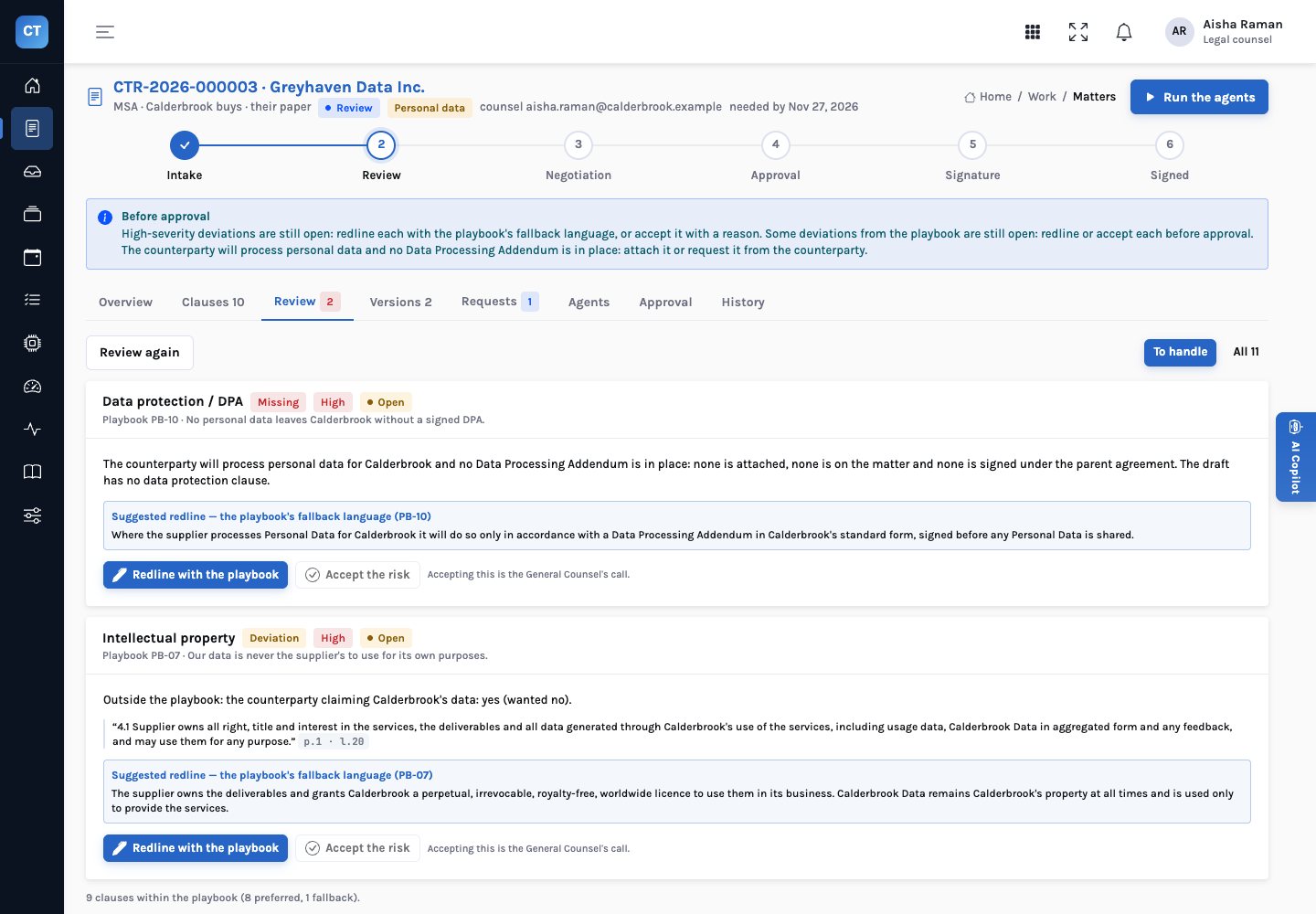
Personal data, no DPA
Greyhaven Data Inc., MSA, US$2.56 million
The request says the supplier will process personal data. The draft has no data protection clause, no DPA is attached, none is on the matter and none is signed under a parent agreement.
- Data protection / DPAmissing; personal data declared on the requesthigh
- Intellectual propertythe counterparty claims Calderbrook’s datahigh
- Control: personal data without a DPArequest the DPA from the counterpartyblocks
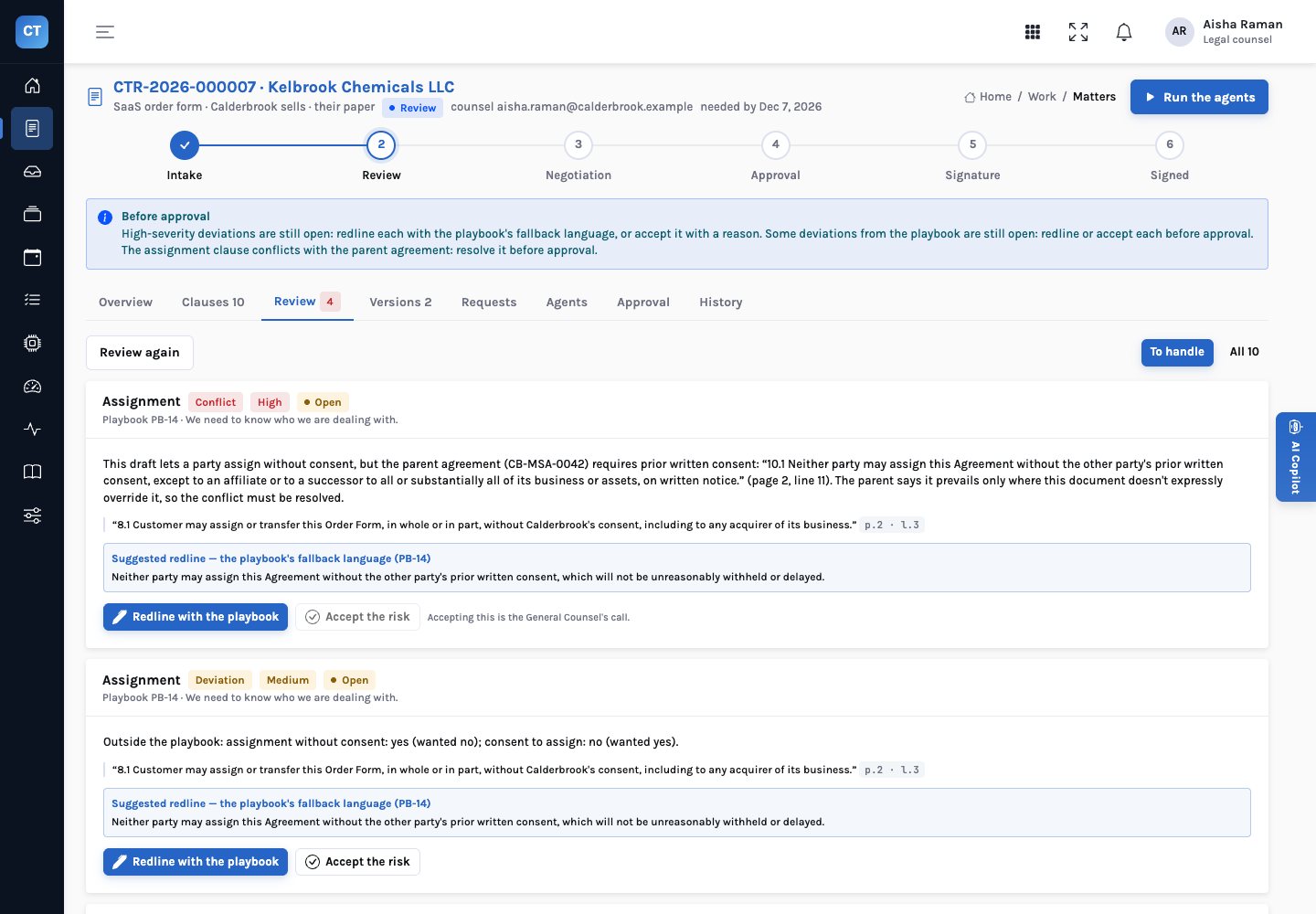
Conflict with the parent
Kelbrook Chemicals LLC, SaaS order form
The order form lets a party assign it without consent. The master agreement it sits under, CB-MSA-0042, requires prior written consent and prevails only where the order form doesn’t expressly override it.
- Assignmentconflicts with section 10.1 of the parent, quoted with page and linehigh
- Governing lawState of Texas: outside the playbookmedium
- Controlsthe conflict blocks; the governing law refers to the General Counselblock
AI agents
Seven agents prepare. None of them sends, signs, accepts or approves.
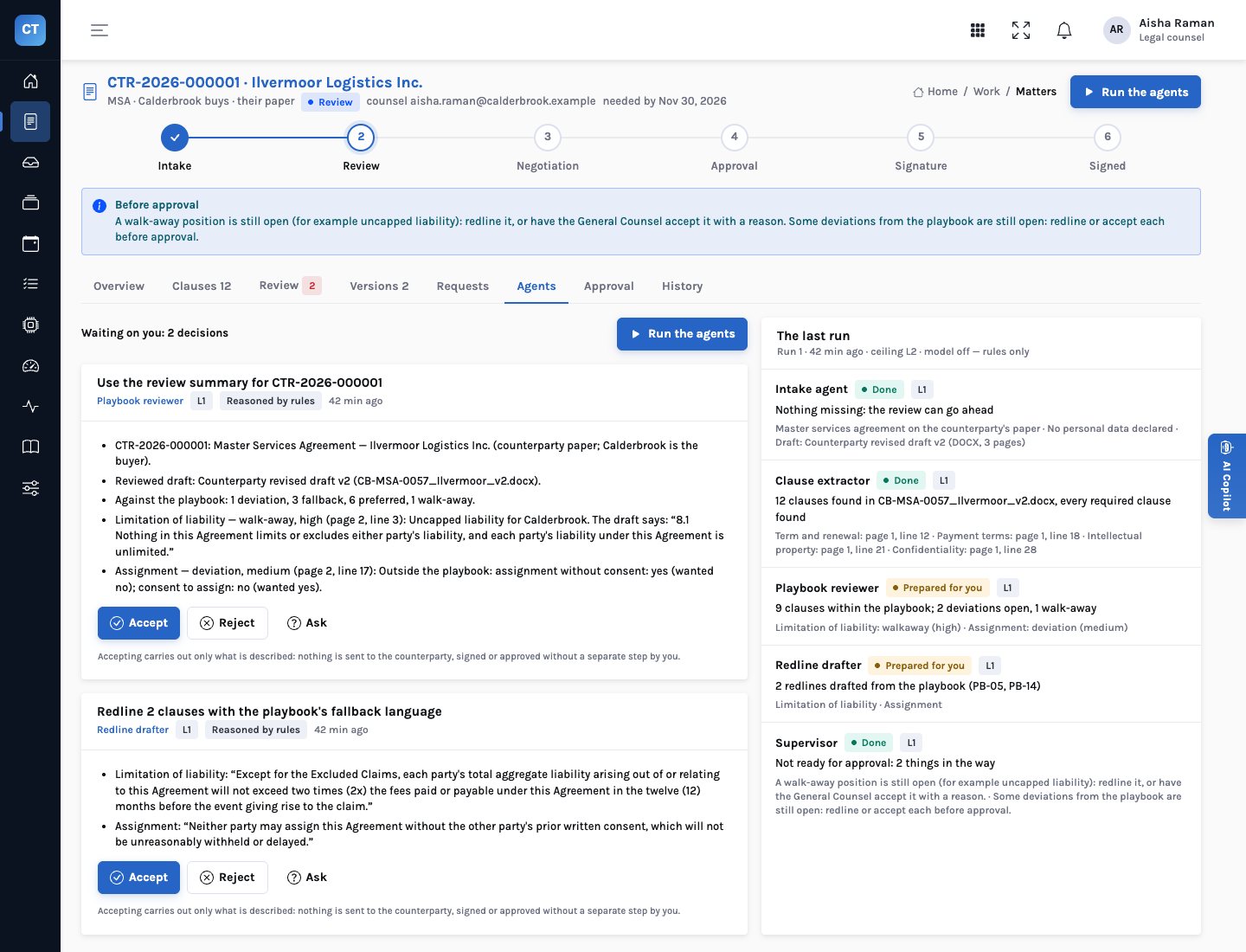
Each agent does one stage and stops at a prepared decision: a review summary to use, redlines to apply, a request to hold for sending, a submission to make. A lawyer accepts, rejects or asks. Every answer goes on the record, and how often lawyers agree is how an agent earns more autonomy, up to a ceiling of L2 (ask first).
- Intake, clause extractor, playbook reviewer — what the matter is, what is missing, every clause and its position
- Redline drafter — the playbook’s fallback language for each open deviation, never its own wording
- Supervisor — runs the approval controls and prepares the submission, to the General Counsel where referred
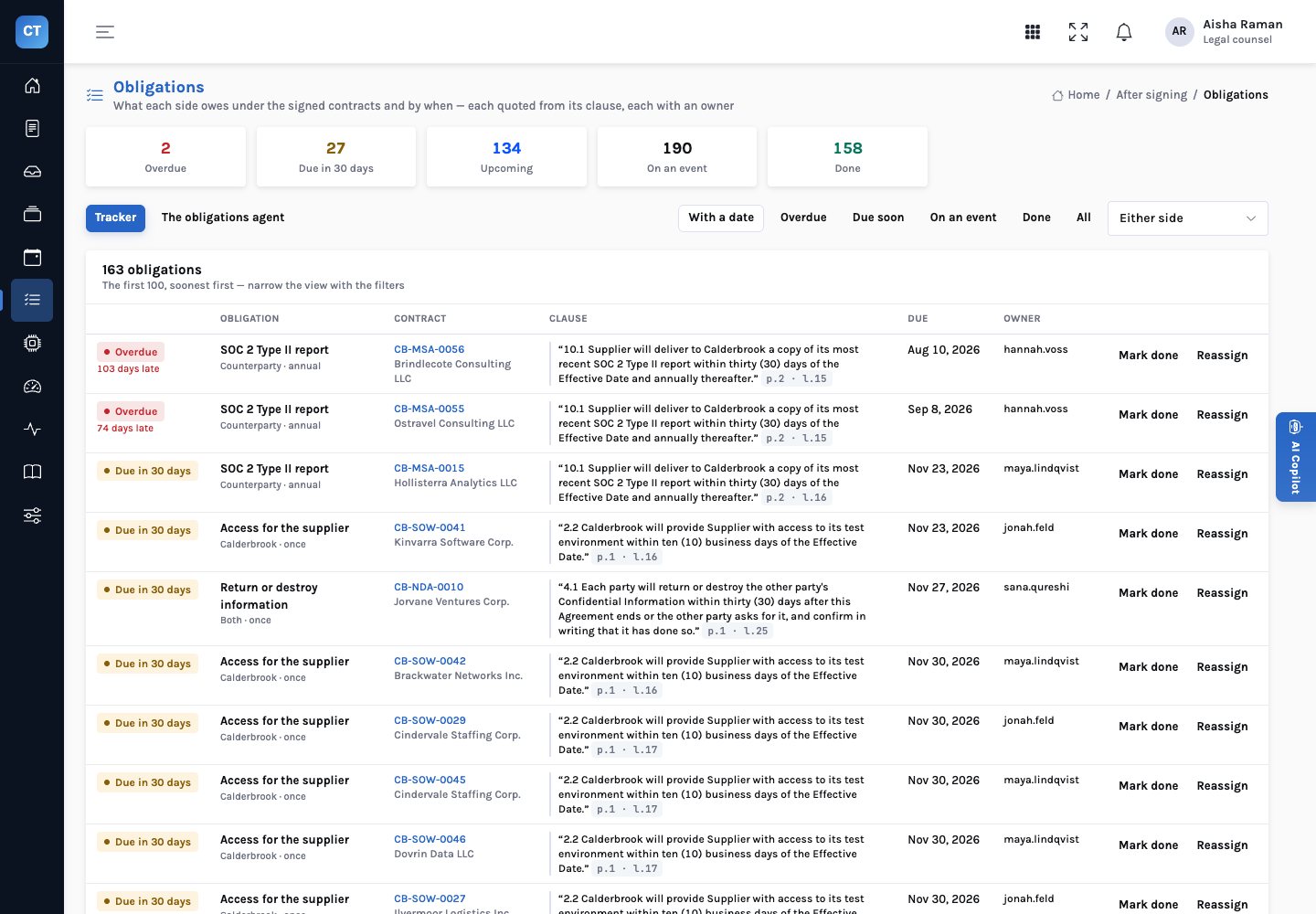
- Obligations and renewals — watch the repository for what is overdue and which notice windows are closing
- Model optional — the reading and the comparison are deterministic; with the model off, the agents run on their rules and say so
After signing
A contract doesn’t end at signature
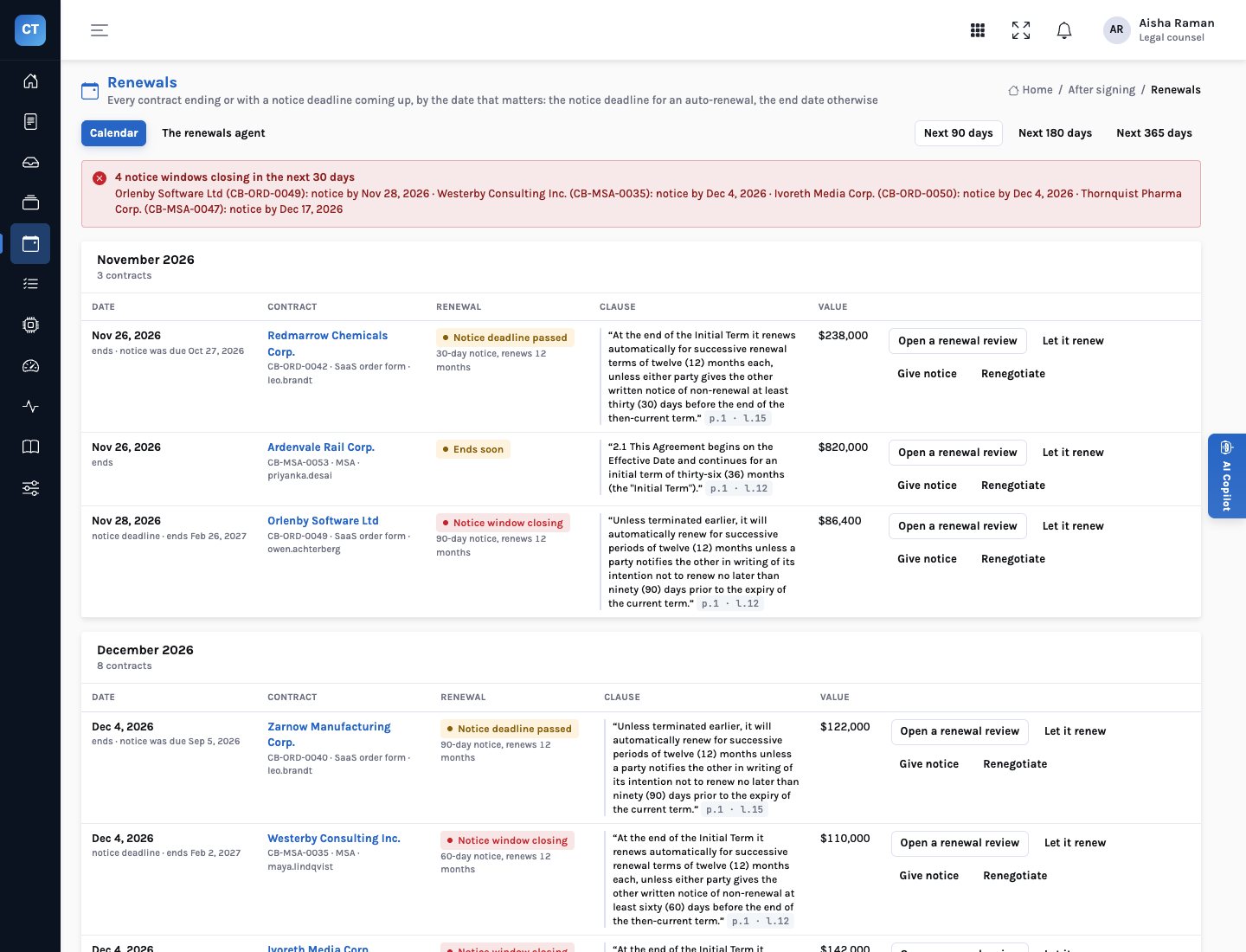
Every executed copy is read the same way as a draft. The repository holds the key terms with page and line, the renewals calendar counts back from the end of term to the notice deadline, and the obligations tracker lists who owes what by when, quoted from the clause.
For General Counsel
Answers for the auditor, and for the board
The questions a General Counsel is asked are simple. InsightContracts keeps the evidence for each answer on the matter, as it was when the decision was made.
Why did we sign this?
The decision record: who submitted, who approved, the draft and version, every control’s outcome, and each deviation’s position and resolution.
Did two people look?
The approver is never the person who submitted. Uncapped liability, governing law outside the playbook and high-value matters go to the General Counsel.
What renews next month?
The renewals calendar shows every notice deadline, which windows are closing and which have passed, with the clause it came from.
What did the AI do?
Every agent step, what it prepared, who answered and how, and the agreement rate that decides whether it earns more autonomy.
Design & trust
Built to be checked
A Python API, a React app and PostgreSQL, designed to run in your own cloud account against your own systems. No clause, position or redline on a matter is something a model made up.
Grounded
Quoted, not generated
Every clause is quoted with its page and line, the same in the PDF, the Word file and the text layer. A clause the reader can’t find is reported missing, never filled in.
Your playbook
Positions as data
Preferred, fallback and walk-away positions, severity and approver are rows you maintain. The redline is your fallback wording, verbatim.
Policy
Controls in Rules Studio
What blocks approval and what goes to the General Counsel are controls you can read, test against a real matter and publish.
Not legal advice
A workbench for lawyers
InsightContracts prepares and records. It doesn’t give legal advice, and nothing reaches a counterparty without a person sending it.