Ilvermoor Logistics sends its own master services agreement for cloud hosting and managed infrastructure, a three-year deal worth US$1.14 million. Two weeks later it sends a revised draft. The revision gives ground on termination and on intellectual property. It does not move on the one clause that matters most: section 8.1 still says each party’s liability “is unlimited”. In the playbook, that is a walk-away position, and only the General Counsel can accept it.
In short
- A walk-away position is not a deviation to trade. The playbook marks uncapped liability as the point where the deal team stops; the redline is the playbook’s fallback cap, and accepting the risk is the General Counsel’s call alone.
- A revised draft is a new document, not a reply. Reading the second draft clause by clause shows what the counterparty gave and what it kept, so nobody assumes the whole draft moved because two clauses did.
- The controls say why the matter can’t be approved, in words. Two block approval; two more route it to the General Counsel when it is ready.
- The agents prepare; the counsel and the General Counsel decide. The redlines are drafted from the playbook and wait on the counsel. Nothing is sent, accepted or approved by an agent.
The situation
This matter is on InsightContracts’ demo data: Calderbrook Systems, Inc., a fictional company,
with fictional counterparties and an illustrative playbook. The playbook is an example of how a
company might write its positions down; it is not legal advice and not anyone’s real policy.
The matter is CTR-2026-000001, opened from intake request REQ-0001: a master
services agreement with Ilvermoor Logistics Inc. (contract CB-MSA-0057), on the
counterparty’s paper, with Calderbrook as the buyer. The business owner is in IT; no personal
data is declared.
| On this matter | |
|---|---|
| Contract | Master services agreement, counterparty’s paper, Calderbrook buys |
| Value | US$1,140,000 over the term (US$380,000 a year); 36-month initial term, renewing for 12 months |
| Drafts | v1 CB-MSA-0057_Ilvermoor_v1.docx received Oct 22, 2026; v2 CB-MSA-0057_Ilvermoor_v2.docx received Nov 5, 2026 |
| Clauses read from v2 | 12 of 12, each quoted with its page and line |
| Against the playbook | 6 preferred, 3 fallback, 1 deviation, 1 walk-away |
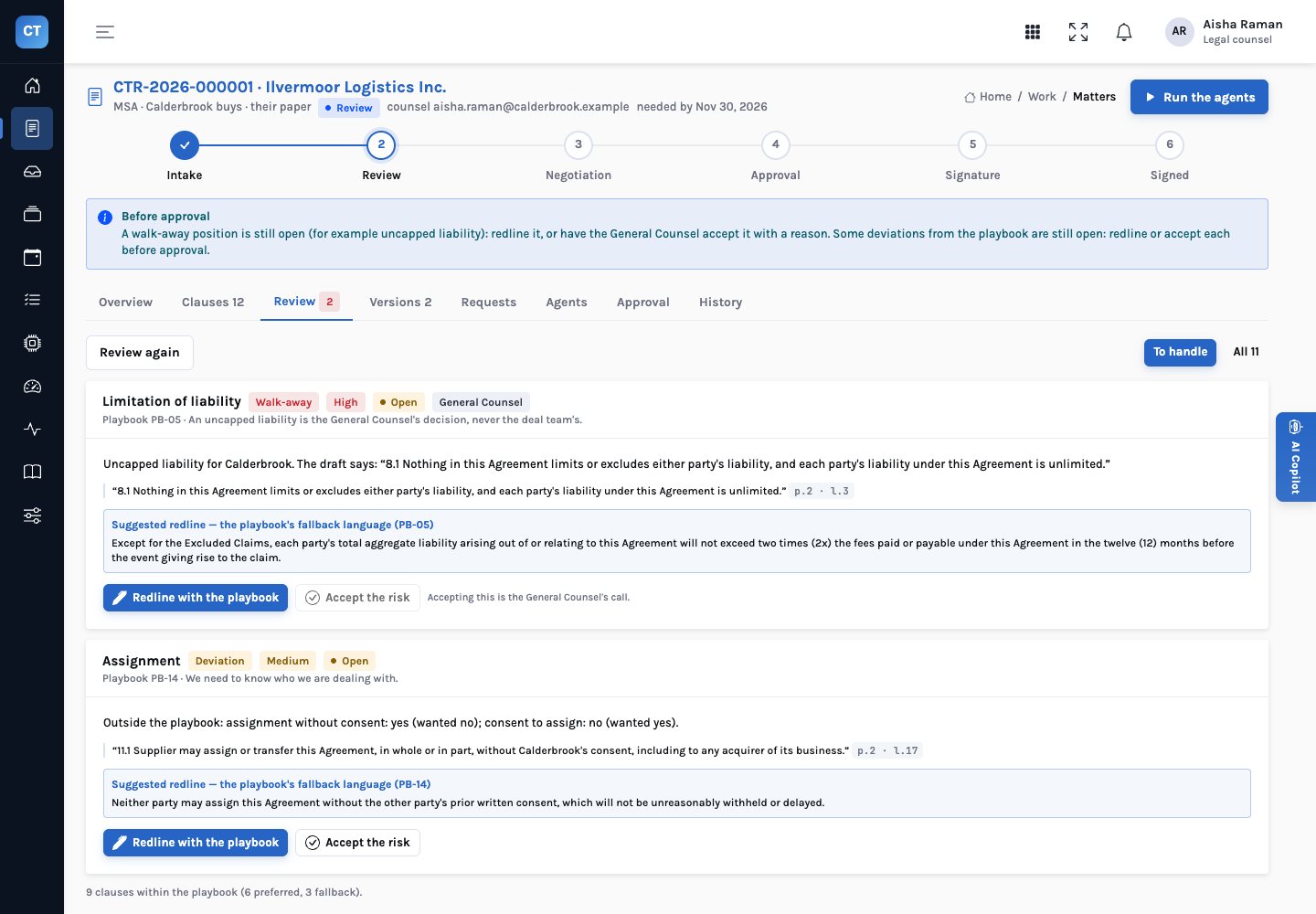
| Open | Limitation of liability (walk-away, high, PB-05) and Assignment (deviation, medium, PB-14) |
The walk-away is section 8.1, on page 2, line 3 of the revised draft:
“8.1 Nothing in this Agreement limits or excludes either party's liability, and each party's liability under this Agreement is unlimited.”
Why this gets missed
Uncapped liability is the clause every lawyer looks for, so it is rarely missed in a first read. What goes wrong is the second draft. A counterparty sends a revision with a cover note listing the changes it accepted. The reviewer, short of time, checks the clauses the note mentions and assumes the rest stands as agreed. If the first-round redline on liability was never sent, or was sent and quietly ignored, the revised draft carries the same sentence forward.
- The cover note is the counterparty’s summary, not a comparison. It says what moved, never what stayed.
- Word’s compare shows lines, not positions. It tells you text changed; it doesn’t tell you that termination went from deviation to preferred and liability did not change at all.
- A walk-away gets negotiated as if it were a deviation. Under deal pressure, “let’s cap it at something” is agreed between the business and the counterparty before the person who owns that decision has seen it.
What changed between the drafts
Both drafts are on the matter. The versions tab compares them clause by clause and word by word, and says where each clause stood against the playbook before and after. Two clauses changed:
| Clause | Draft 1 | Draft 2 | What changed |
|---|---|---|---|
| Termination (§9.1) | Deviation | Preferred | “Neither party may terminate … during the Initial Term” became “Calderbrook may terminate this Agreement for convenience on thirty (30) days' written notice to Supplier.” |
| Intellectual property (§4.1) | Deviation | Fallback | The supplier no longer claims “all data generated through Calderbrook's use of the services”; it now grants a perpetual licence to the deliverables, and “Calderbrook Data remains Calderbrook's property at all times”. |
| Limitation of liability (§8.1) | — | Walk-away | Not in the list of changed clauses: the unlimited-liability sentence is in the revised draft as it stands. |
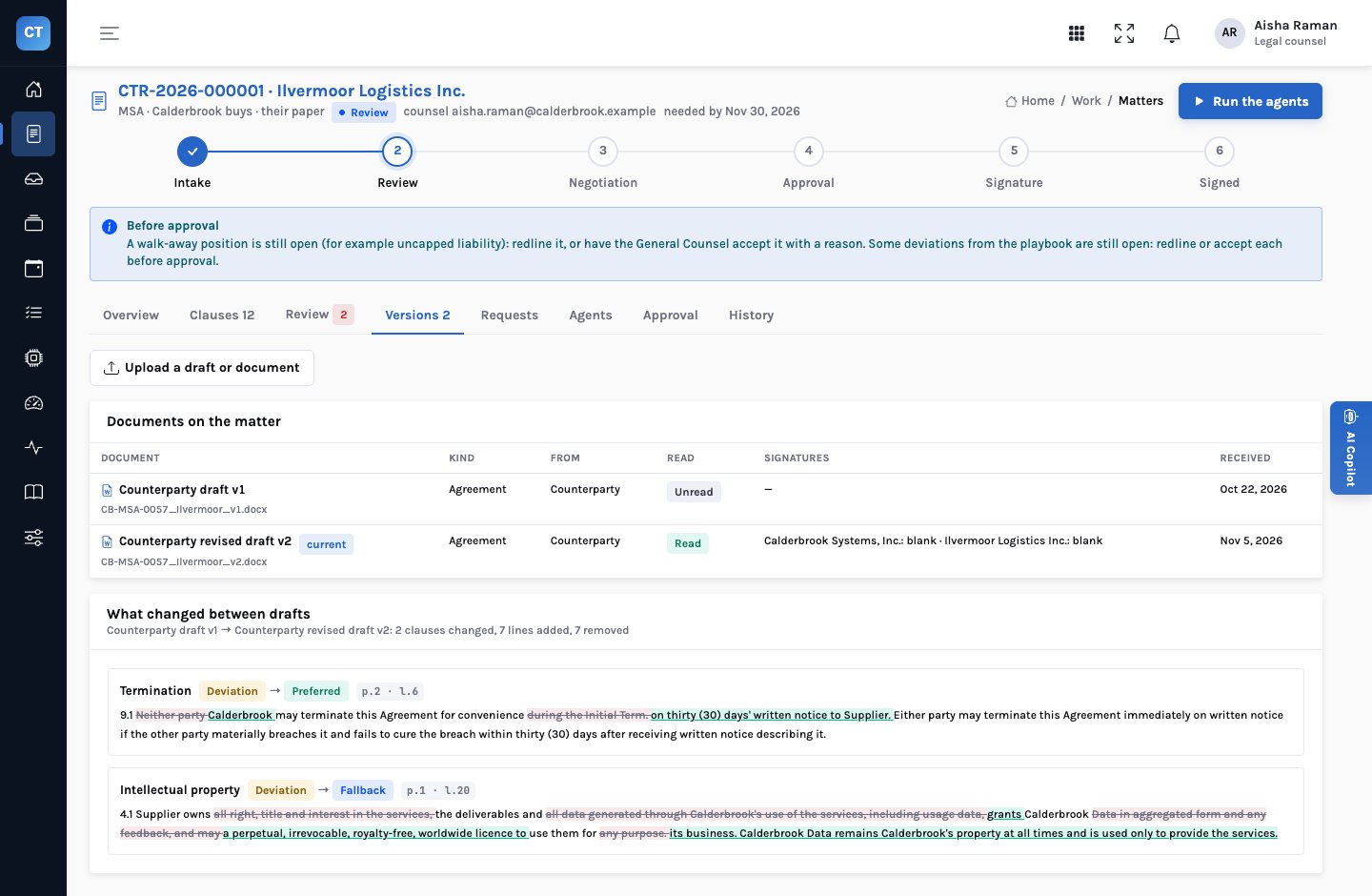
The revised draft moved on two clauses. The one the playbook treats as a walk-away is the one it kept.
How InsightContracts reads it
The clause reader turns the draft into clauses: parties, term and renewal, the auto-renewal notice, termination, limitation of liability, indemnity, IP, confidentiality, data protection, governing law, payment terms and assignment. Each is quoted with its page and line. The line count is the same in the PDF, the Word file and the text layer, so “page 2, line 3” points at the same words whichever copy someone opens. The reader is deterministic: if it can’t find a clause, it says the clause is missing rather than guessing.
The playbook reviewer then compares every clause with the company’s positions. For liability
(PB-05) the playbook has a preferred cap of twelve months’ fees, a fallback of two
times twelve months’ fees, and a walk-away: “Uncapped liability for Calderbrook.”
The reader took uncapped: true from section 8.1, which meets the walk-away rule, so the
finding is a walk-away, high severity, approver the General Counsel, with the playbook’s
guidance beside it: “An uncapped liability is the General Counsel's decision, never the deal
team's.”
The second open finding is assignment. Section 11.1 lets the supplier “assign or transfer this
Agreement, in whole or in part, without Calderbrook's consent, including to any acquirer of its
business” (page 2, line 17). The playbook (PB-14) wants consent; it is a
medium-severity deviation a legal counsel can handle.
Who does what
Every agent ran at L1 with the model switched off in the demo: rules only, and each step says so.
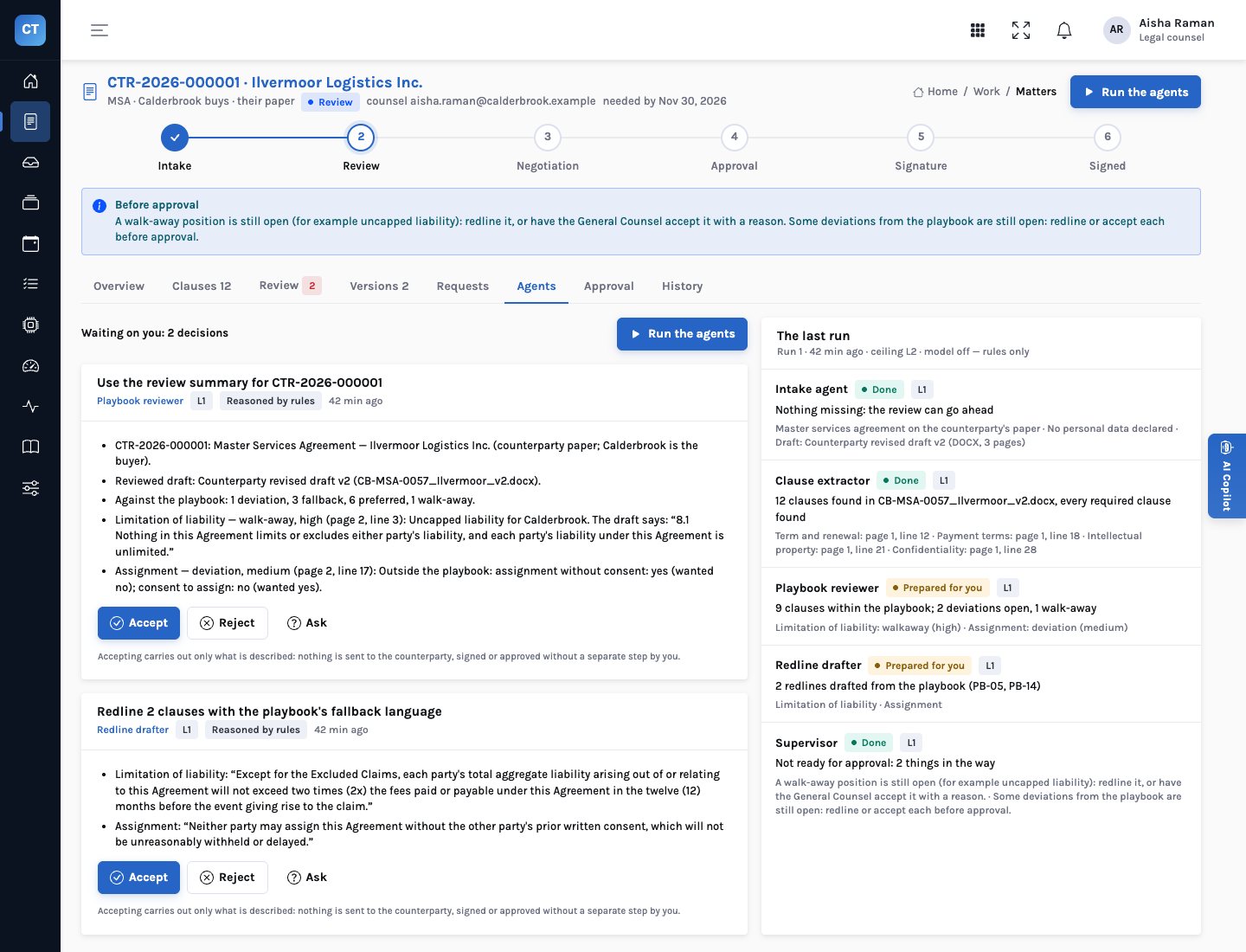
Reads v2 into twelve clauses with page and line; every required clause found.
One walk-away (liability, high) and one deviation (assignment, medium); nine clauses within the playbook. Prepares a review summary for the counsel to use.
Two redlines, each the playbook’s fallback language verbatim: the 2x cap from PB-05 and the consent wording from PB-14. Prepared, not applied.
Redline with the playbook, or accept with a reason. The counsel can redline the liability clause but cannot accept it: accepting a walk-away is reserved to the General Counsel.
Accepting the redlines holds a request on the Requests tab. A person sends it; the counterparty answers through a link with no login.
A revised draft uploaded through the link becomes version 3, read, reviewed and compared at once. A redline the counterparty took resolves its finding; one it didn’t take reopens.
Once nothing blocks, the counsel submits. Uncapped liability and the value both refer the matter to the General Counsel, who is not the submitter.
What the controls say
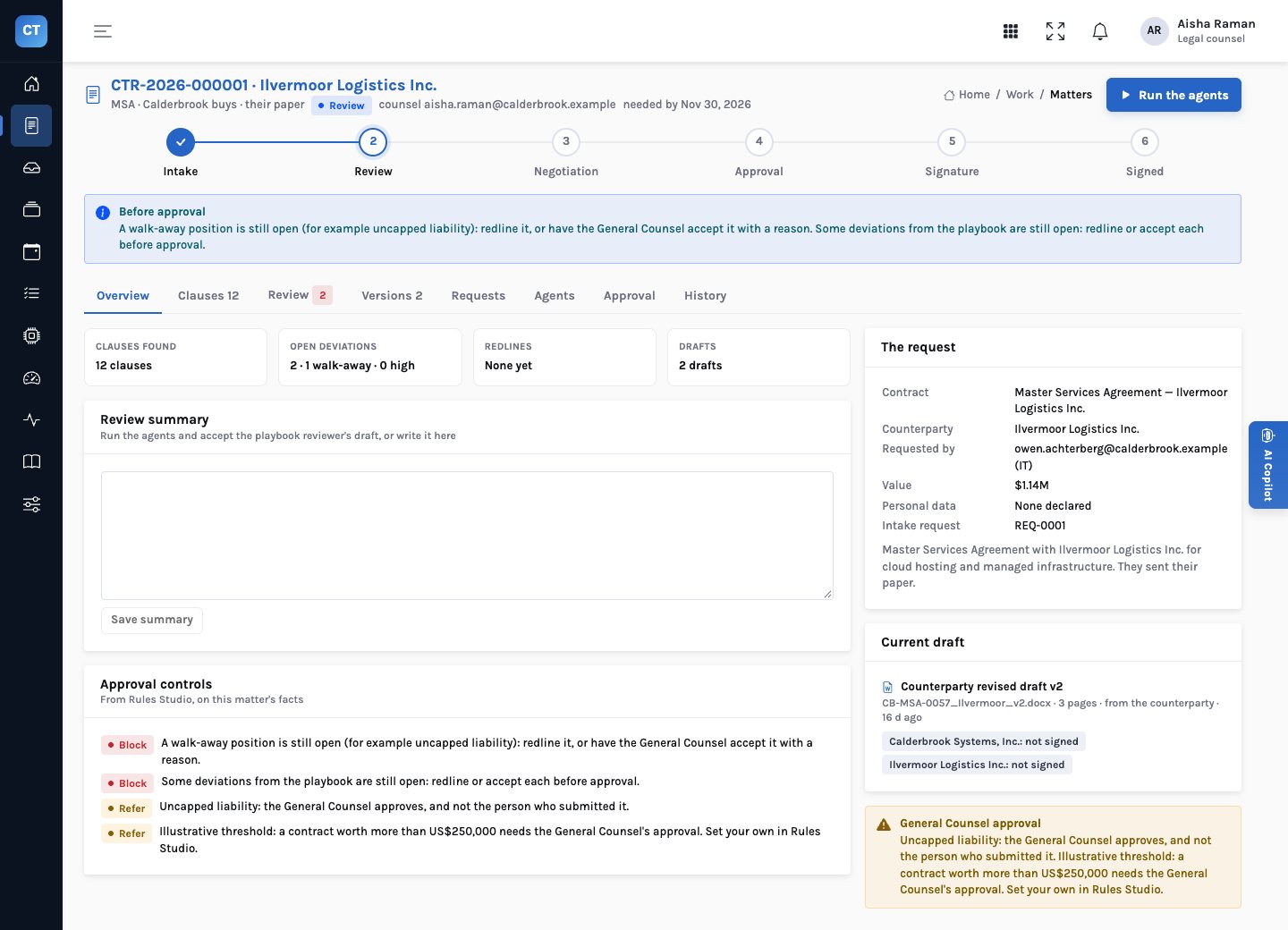
The approval controls are rules in Rules Studio, evaluated on the matter’s facts. On this matter, four of the ten have something to say:
| Control | Outcome | Why |
|---|---|---|
| A walk-away position is open | Block | Liability is uncapped and neither redlined nor accepted |
| Deviations open | Block | Two findings still open |
| Uncapped liability needs the General Counsel | Refer | The draft’s liability is uncapped |
| High-value contract (illustrative threshold) | Refer | US$1.14 million is above the illustrative US$250,000; set your own in Rules Studio |
A redlined finding still counts as open for these controls until the counterparty’s next draft is within the playbook. Redlining moves the matter into negotiation; it doesn’t make the sentence in section 8.1 go away. The block lifts when a draft arrives with a cap, or when the General Counsel accepts the risk in writing.
The decision, and whose it is
There are two ways forward, and the product doesn’t choose between them.
The counsel sends the PB-05 fallback: liability capped at two times the fees in the twelve months before the claim, except for the Excluded Claims. If Ilvermoor’s next draft takes it, the walk-away resolves on that draft.
Only the General Counsel can accept a walk-away, and only with a written reason. The acceptance is recorded with the finding, and the GC-positions control then refers the approval to the General Counsel as well.
Either way, the approval itself is four eyes. The counsel who submits the matter can’t approve it, and because two controls refer it, the approver must be the General Counsel. The decision record keeps every control’s outcome and each finding’s position and resolution as they stood at the moment of the decision.
Ask the matter, not a search engine
The copilot answers questions about the open matter with read-only tools. Asked “What still blocks approval of this contract?” on this matter, it lists the walk-away, the open deviations and the two referrals. With the model switched off, as in the demo, it answers from the matter’s headline facts and says so. It can’t change anything.
What it means for each audience
For the General Counsel
Walk-away positions exist so that one decision is always yours. Here the product holds it for you: the counsel can push back with the playbook’s cap, but nobody below you can accept unlimited liability, and the record shows who did.
If you do accept it, the reason sits on the finding and the decision record, beside the draft it applied to.
For legal operations
The second draft is reviewed with the same rigour as the first, in seconds, and the comparison shows exactly which redlines were taken.
Counsel time goes on the two open findings, not on re-reading nine clauses that were already fine.
For the board
The company doesn’t sign unlimited liability by accident, and when it signs it on purpose, a named person decided, with a reason.
That is the question an auditor or a board asks after a claim.
What to be careful about
- The playbook is yours to write. Calderbrook’s positions on liability are illustrative. Where your walk-away sits, and what your fallback cap is, is a legal and commercial decision for your own counsel.
- The reader reads words, not intent. It recognises a clause that says liability is unlimited. Liability left uncapped by silence, or capped in one clause and uncapped in a schedule, still needs a lawyer’s read of the whole document.
- A revised draft must be uploaded to be compared. A change agreed by email and never put into a draft is invisible to the review.
The counterparty decides what to change. The comparison shows what it didn’t.
Read every draft against the playbook, compare it with the last one, and keep the walk-away decision with the one person who owns it.