Calderbrook’s People team wants Greyhaven Data to run recruitment and contingent staffing: a four-year master services agreement worth US$2.56 million. Recruitment means candidates’ names, contact details and work histories. Greyhaven will be handling personal data for Calderbrook. Its draft has no data protection clause at all, no Data Processing Addendum is attached, and none is signed anywhere else in the contract family. Its revised draft fixed the liability cap and the indemnity. It did not add a word about personal data.
In short
- A services agreement under which a supplier processes personal data needs data processing terms. Under the GDPR that is Article 28; several US state privacy laws ask for similar written terms with service providers.
- The gap is an absence, which is why it gets missed. Reviewers mark up what a draft says; a DPA that was never attached leaves nothing to mark up.
- InsightContracts checks the whole contract family, not just the draft: a DPA attached as an exhibit, a DPA on the matter, or one signed under a parent agreement. Here there is none of the three.
- The missing DPA blocks approval until it is in place, and the request for it is held until a person sends it. On this matter it has been sent and is waiting on Greyhaven.
The situation
This matter is on InsightContracts’ demo data: Calderbrook Systems, Inc. and Greyhaven Data Inc.
are fictional, and the playbook is illustrative, not legal advice. The matter is
CTR-2026-000003, from intake request REQ-0003: a master services agreement
(CB-MSA-0058) on Greyhaven’s paper, Calderbrook buying, for “recruitment and
contingent staffing”. The intake request declares that personal data will be processed.
| On this matter | |
|---|---|
| Contract | Master services agreement, counterparty’s paper, Calderbrook buys; business owner in People |
| Value and term | US$2,560,000 (US$640,000 a year); 48-month initial term |
| Personal data | Declared on the intake request |
| Drafts | v1 received Oct 12, 2026; v2 CB-MSA-0058_Greyhaven_v2.docx received Oct 25, 2026 |
| Clauses read from v2 | 10: no data protection clause, no auto-renewal clause |
| Open | Data protection / DPA (missing, high, PB-10) and Intellectual property (deviation, high, PB-07) |
What the law asks of the contract
Under the EU and UK GDPR, when a controller uses a processor, Article 28(3) requires the processing to be governed by a contract (or other legal act) that sets out the subject matter and duration of the processing, its nature and purpose, the types of personal data and categories of data subjects, and the controller’s obligations and rights. It then lists terms the processor must commit to:
- process the personal data only on the controller’s documented instructions, including on transfers outside the EU or UK;
- ensure the people authorised to process it are bound by confidentiality;
- take the security measures Article 32 requires;
- engage sub-processors only with the controller’s authorisation, and on the same data protection obligations;
- help the controller respond to data subjects exercising their rights, and with its obligations on security, breach notification and data protection impact assessments;
- delete or return the personal data at the end of the services;
- make available the information needed to demonstrate compliance, and allow for audits.
In practice companies put these terms in a Data Processing Addendum. In the United States there is no single equivalent, but several state privacy laws, California’s among them, require contracts with service providers or processors that limit how they use the personal data they receive. Which law applies depends on whose data it is and where; that is a question for your privacy counsel, and nothing here is legal advice.
Why a general compliance promise isn’t enough
A clause that says the supplier “will comply with applicable data protection laws” doesn’t contain the terms Article 28(3) lists. InsightContracts treats that clause, where personal data is processed, as a high-severity deviation of its own. On Greyhaven’s draft there isn’t even that: the data protection clause is absent.
Why this gets missed
- Absence leaves no mark. A reviewer reading Greyhaven’s draft finds ten clauses, all with something to say. Nothing on the page prompts the question “where is the DPA?”
- The DPA might exist elsewhere. It could be signed under a master agreement, sent separately, or promised in an email. Checking means searching the repository, and that is the step that gets skipped.
- The personal data is in the intake request, not the contract. The agreement says “recruitment and contingent staffing”; it is the business owner’s request that says personal data will be processed. The two are rarely read side by side.
- The second draft focuses attention elsewhere. Greyhaven’s revision fixed liability and indemnity, which is satisfying to see and easy to stop at.
How InsightContracts finds it
The DPA check runs on every review where personal data is declared and the contract is a master services agreement, a SaaS order form, a supply agreement or a statement of work. It looks in three places before it raises anything:
On Greyhaven’s matter the answer is no three times, and there is no parent agreement to look under.
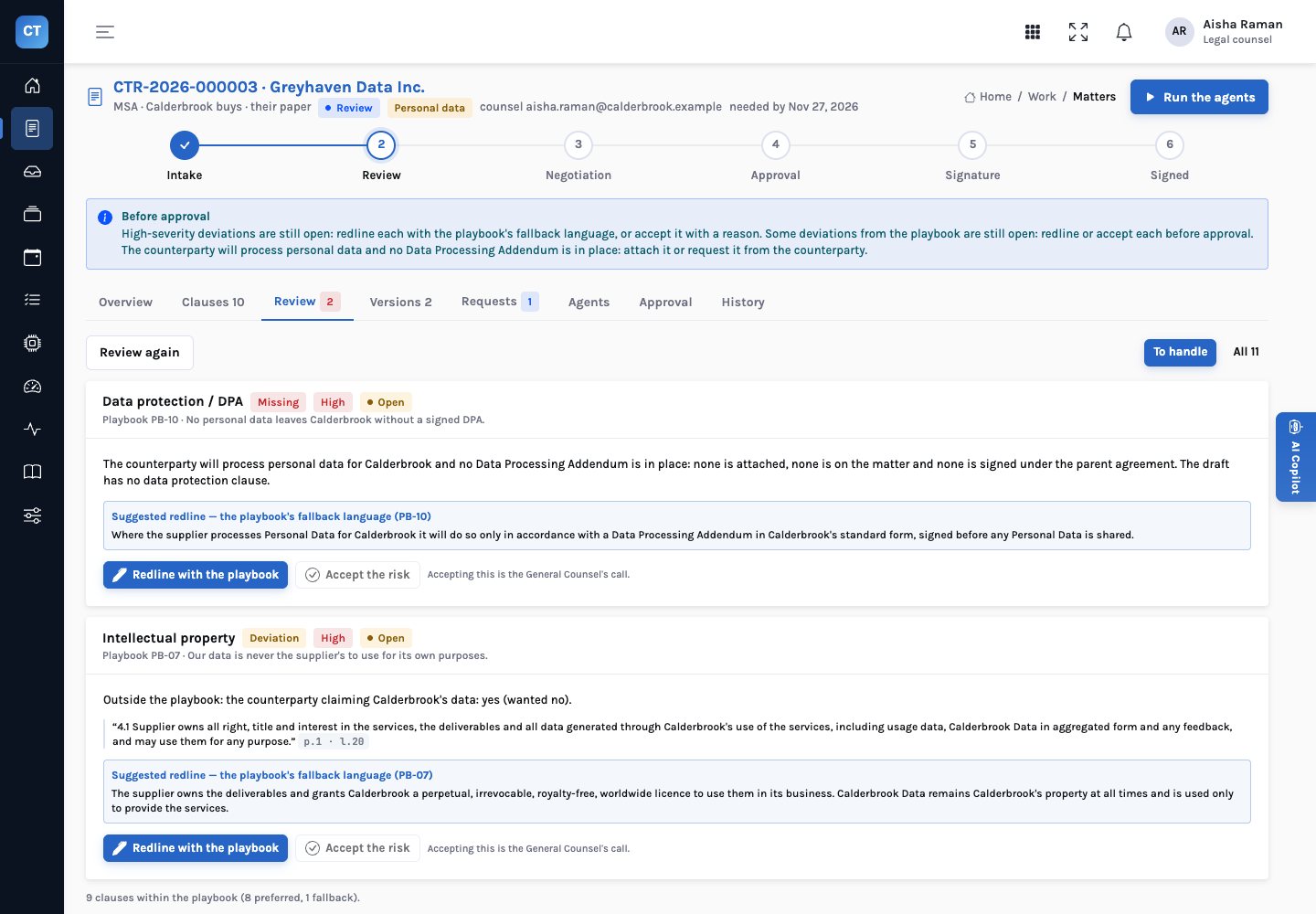
When it finds nothing, it raises one finding that says all of it: “The counterparty will
process personal data for Calderbrook and no Data Processing Addendum is in place: none is attached,
none is on the matter and none is signed under the parent agreement. The draft has no data protection
clause.” Severity is high, from the playbook’s data protection position
(PB-10), and the guidance shown with it is the playbook’s: “No personal data
leaves Calderbrook without a signed DPA.”
The suggested redline is the playbook’s fallback language, copied exactly: “Where the supplier processes Personal Data for Calderbrook it will do so only in accordance with a Data Processing Addendum in Calderbrook's standard form, signed before any Personal Data is shared.” No model writes clause language.
The second problem: whose data is it?
The other open finding makes the first one worse. Section 4.1, on page 1, line 20, reads:
“4.1 Supplier owns all right, title and interest in the services, the deliverables and all data generated through Calderbrook's use of the services, including usage data, Calderbrook Data in aggregated form and any feedback, and may use them for any purpose.”
For a recruitment service, “data generated through Calderbrook's use of the services”
could include information about candidates. The playbook position for IP (PB-07) is that
Calderbrook’s data is never the supplier’s to use for its own purposes; the clause is a
high-severity deviation, and the fallback language keeps Calderbrook Data “Calderbrook's
property at all times”, “used only to provide the services”. Whether a supplier may
use personal data for its own purposes is also a question data protection law has a view on, which is
why both findings belong in the same conversation with Greyhaven.
| Clause | Draft 1 | Draft 2 |
|---|---|---|
| Limitation of liability | Deviation: three months’ fees, no Excluded Claims | Preferred: twelve months’ fees, with Excluded Claims |
| Indemnity | Deviation: a broad indemnity from Calderbrook | Preferred: mutual IP indemnity |
| Intellectual property | Deviation, high | Unchanged: deviation, high |
| Data protection | No clause | No clause |
Who does what
Notes the MSA is on the counterparty’s paper and personal data will be processed; lists one thing missing: “Your signed Data Processing Addendum (or confirm you'll sign Calderbrook's standard DPA)”.
Ten clauses from v2, each with page and line. No data protection clause is among them.
Two high-severity findings open: the missing DPA and the IP deviation. Prepares the review summary.
Two redlines from the playbook, PB-07 and PB-10, verbatim. Prepared for the counsel.
Reviews the request the agent prepared, edits it if needed, adds the recipient and sends it. On this matter it was sent on Nov 21, 2026 by the counsel, due Nov 28.
A signed DPA uploaded through the link is filed on the matter as a DPA document; the next review finds it and the DPA-missing finding no longer applies. Nothing has come back yet.
The value is above the illustrative US$250,000 threshold, so once nothing blocks, the General Counsel approves. The submitter can’t.
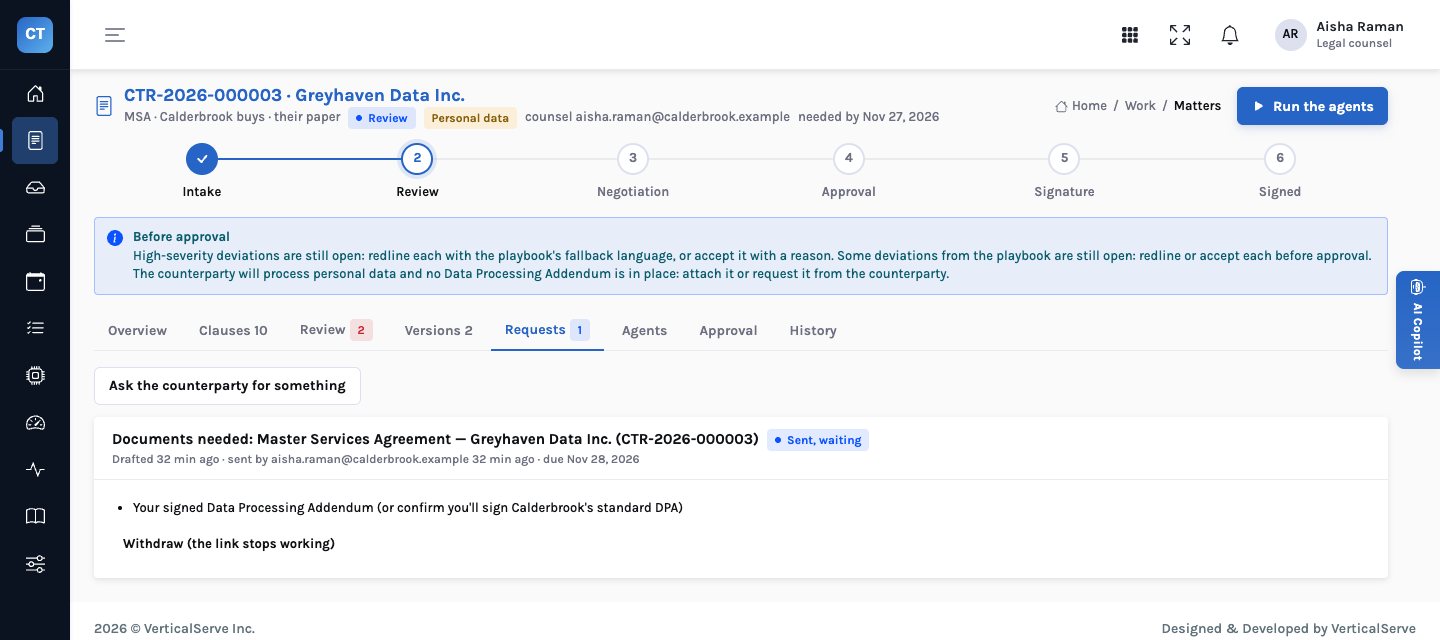
The request went out with a link that needs no login. Greyhaven can upload the DPA through it; the upload is read on arrival and filed on the matter. InsightContracts stores only a fingerprint of the link’s token, and an agent cannot send a request: a person releases every one.
What the controls say
| Control | Outcome | On this matter |
|---|---|---|
| Personal data without a DPA | Block | No DPA attached, on the matter or under a parent |
| High-severity deviations open | Block | Intellectual property and the missing DPA, both high |
| Deviations open | Block | Two findings open |
| High-value contract (illustrative threshold) | Refer | US$2.56 million is above the illustrative US$250,000 |
There is no quick way around the DPA block. Accepting a missing DPA is a high-severity acceptance, so only the General Counsel could do it, with a reason on the record; the playbook’s own guidance says not to. The expected path is the one already under way: get the DPA, upload it, review again.
What it means for each audience
For the General Counsel
No contract under which a supplier processes the company’s personal data reaches signature without a DPA, unless you decide otherwise in writing.
When a regulator or a data subject asks what terms governed the supplier, the answer is on the matter.
For legal operations
The check looks across the contract family, so a DPA signed two years ago under a master agreement counts and nobody has to search for it.
The request is drafted with the exact item to ask for; the counsel edits and sends.
For the board
The privacy programme and the contract process use the same facts. Personal data declared at intake follows the matter to approval.
A gap that is invisible on the page is caught by the process.
What to be careful about
- The check depends on the declaration. If the intake request doesn’t say personal data will be processed, the DPA check doesn’t run. The business owner’s answer at intake matters.
- A DPA on file is not a good DPA. InsightContracts checks that one is in place; it doesn’t assess whether its terms meet Article 28 or a state law. That is your privacy counsel’s review.
- Roles matter. Article 28 applies where the supplier acts as a processor. Where a supplier is an independent controller, different terms apply. Decide which it is before choosing the paper.
The hardest clause to review is the one that isn’t there.
Check the whole contract family for the DPA, block approval until it is in place, and ask the counterparty for it in one specific sentence.