A software subscription ends on 26 February. The team that uses it decides in January that it wants to switch, and asks legal to let it lapse. Too late: the order form renews automatically for twelve months unless notice is given ninety days before the end of the term, and that deadline was 28 November. The date that mattered was never the end date. It was the notice date, three months earlier, and nobody had it in a calendar.
In short
- For an auto-renewing contract, the notice deadline is the date that matters. It is the end of the current term less the notice period, and it can fall months before the end date.
- Both numbers come from the executed copy. InsightContracts reads the term and the notice period from the signed contract, with the clause quoted by page and line.
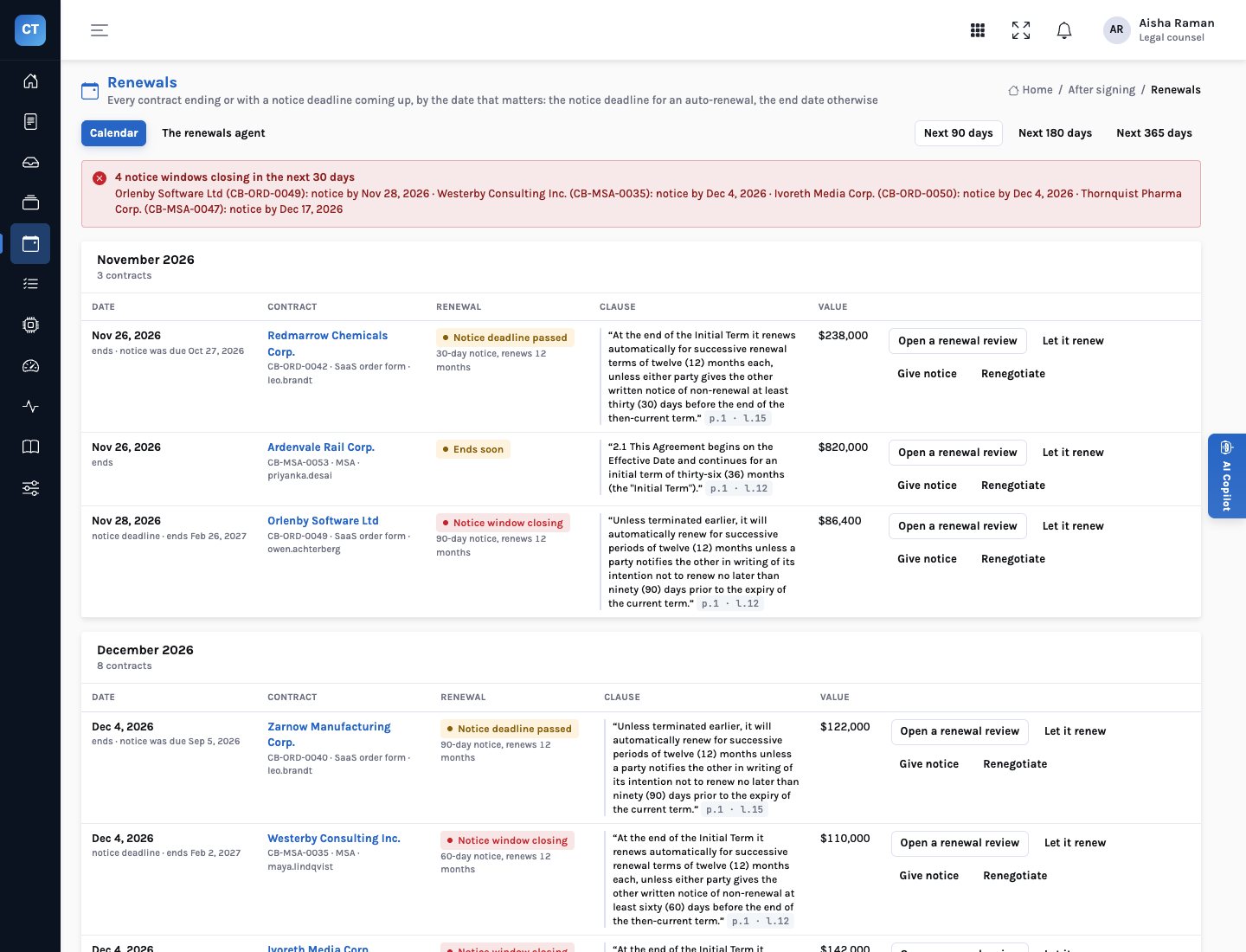
- The calendar counts backwards. Contracts are listed by notice deadline, with windows closing in the next 30 days at the top, and the renewals agent prepares a review 45 days out.
- The decision is a person’s. Renew, give notice or renegotiate. InsightContracts records the decision; the owner sends the notice.
The arithmetic everybody gets wrong
An evergreen clause usually reads something like this one, from a SaaS order form in the demo repository: “Unless terminated earlier, it will automatically renew for successive periods of twelve (12) months unless a party notifies the other in writing of its intention not to renew no later than ninety (90) days prior to the expiry of the current term.” Three numbers live in that sentence: the renewal term, the notice period and, implicitly, the end of the current term. Only one date can actually be acted on.
Illustrative timeline for CB-ORD-0049 in the demo: the term ends 26 Feb 2027 and the notice period is 90 days, so the deadline is 28 Nov 2026. (Start dates on the bars are for illustration.)
The rule InsightContracts applies is the one in the clause: notice deadline = end of the current term − the notice period. For the Orlenby Software order form, 26 February 2027 less 90 days is 28 November 2026. As the demo runs on 21 November, that is seven days away. A contract that auto-renews and whose deadline has passed has, in effect, renewed; the calendar shows it as “notice deadline passed” rather than hiding it.
| Status | What it means | Demo example |
|---|---|---|
| Notice deadline passed | Auto-renews and the deadline is behind us | Zarnow Manufacturing order form (CB-ORD-0040): 90-day notice, deadline was 5 Sep 2026, term ends 4 Dec 2026 |
| Notice window closing | Auto-renews and the deadline is within 30 days | Orlenby Software (CB-ORD-0049): notice by 28 Nov 2026; Westerby Consulting (CB-MSA-0035): 60-day notice, by 4 Dec 2026 |
| Auto-renews | Auto-renews and the deadline is further out | Oakhurst Electronics supply agreement (CB-SUP-0030): 30-day notice, by 24 Dec 2026 |
| Ends soon | No auto-renewal; the term ends within 90 days | Ardenvale Rail MSA (CB-MSA-0053): ends 26 Nov 2026 |
| Fixed term | No auto-renewal and nothing due soon | — |
Every company and contract in the table is fictional: they are from Calderbrook Systems, Inc., the invented company the demo runs on.
Reading it from the signed contract
Renewal dates typed into a contract register by hand drift: an amendment extends the term, someone records the renewal term as the notice period, a 60 becomes a 90. InsightContracts reads the term and the notice period from the executed copy itself, the same way it reads a draft in review, and keeps the quote with its page and line beside the date. When someone asks “where does 28 November come from?”, the clause is one click away.
Who does what before the window shuts
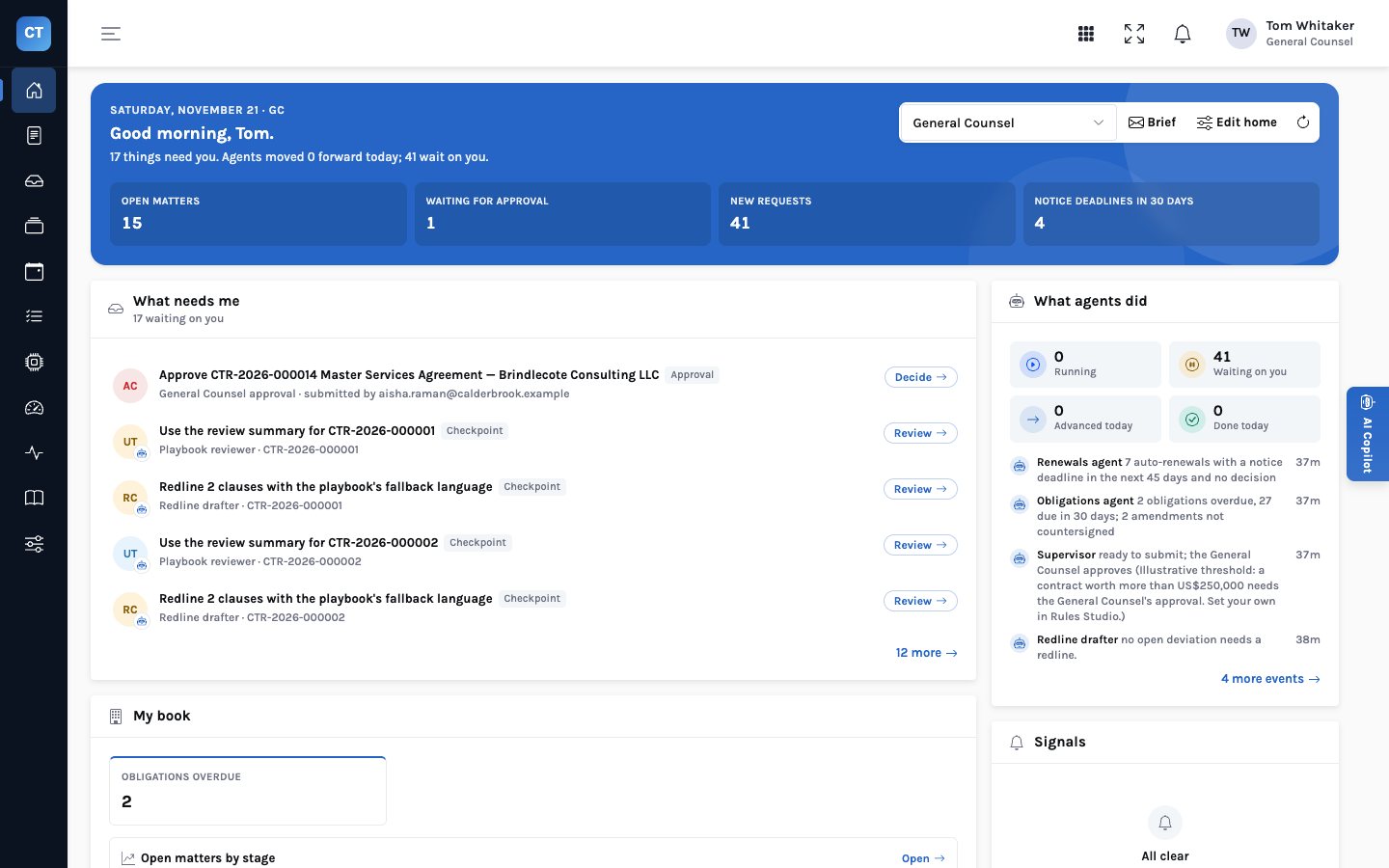
On each portfolio run it lists every auto-renewal with a notice deadline in the next 45 days and no decision. In the demo’s run that was seven contracts.
For each, a prepared decision with the deadline, the clause quoted with page and line, the annual value from the register and the owner. Nothing is decided.
Accepting opens a renewal matter, so the contract can be re-read against today’s playbook before anyone commits to another term.
Let it renew, give notice, or renegotiate. Giving notice needs a reason. The decision and who made it are recorded on the contract.
InsightContracts records the decision; it doesn’t send the notice of non-renewal. The contract says how notice must be given, and a person gives it.
Why the agent can’t just give notice
Sending a notice of non-renewal is a legal act with consequences either way: a lapsed tool the business needed, or a renewal the business didn’t want. It is also usually required in a particular form, to a particular address. The renewals agent is capped, like every InsightContracts agent, at preparing; deciding a renewal is refused for an agent in the code, not just discouraged.
What the law says about auto-renewals
Most automatic-renewal statutes protect consumers rather than businesses. California’s Automatic Renewal Law (Business and Professions Code section 17600 and following), for example, sets disclosure, consent and cancellation requirements for offers made to consumers. Between two businesses, the contract usually governs, which is exactly why the notice date has to be tracked.
There are exceptions worth knowing. New York’s General Obligations Law section 5-903 provides that an automatic renewal provision in a contract for service, maintenance or repair to or for real or personal property is not enforceable against the recipient unless the provider gave written notice calling attention to it, at least 15 and not more than 30 days before the time for giving notice of non-renewal. Whether it applies to a given contract (a software subscription, say) is a question for counsel, and courts have read its scope narrowly in some cases. Other states and countries have their own rules.
Not legal advice
This section is a pointer, not an opinion. Whether a renewal statute applies depends on the contract, the parties and the jurisdiction. Check with your own counsel; InsightContracts tracks the dates your contracts state, it doesn’t decide what the law requires of them.
A renewal is also a second chance to review
A contract signed three years ago was negotiated against a different playbook, or none. A renewal review opens a matter on the executed copy, so the same reader and the same playbook positions apply: the uncapped liability that slipped through in 2023 is a finding now, before another twelve months are committed. Whether to renegotiate is still the owner’s call, but it is an informed one.
For the General Counsel
Renewals stop being a source of surprise spend and surprise lapses.
Each decision (renew, give notice, renegotiate) has an owner and a reason on record.
For legal operations
The calendar is built from the signed contracts, with the clause behind every date.
Windows closing in the next 30 days are at the top of the page, not in someone’s inbox.
For the board
Committed spend that renews silently becomes visible a quarter ahead.
Vendor consolidation and renegotiation happen on the company’s timetable, not the supplier’s.
Put the notice date in the calendar, not the end date.
Everything else (who decides, what to renegotiate, how to give notice) depends on knowing that date in time.
The demo company, its contracts and dates are fictional. Nothing in this post is legal advice.