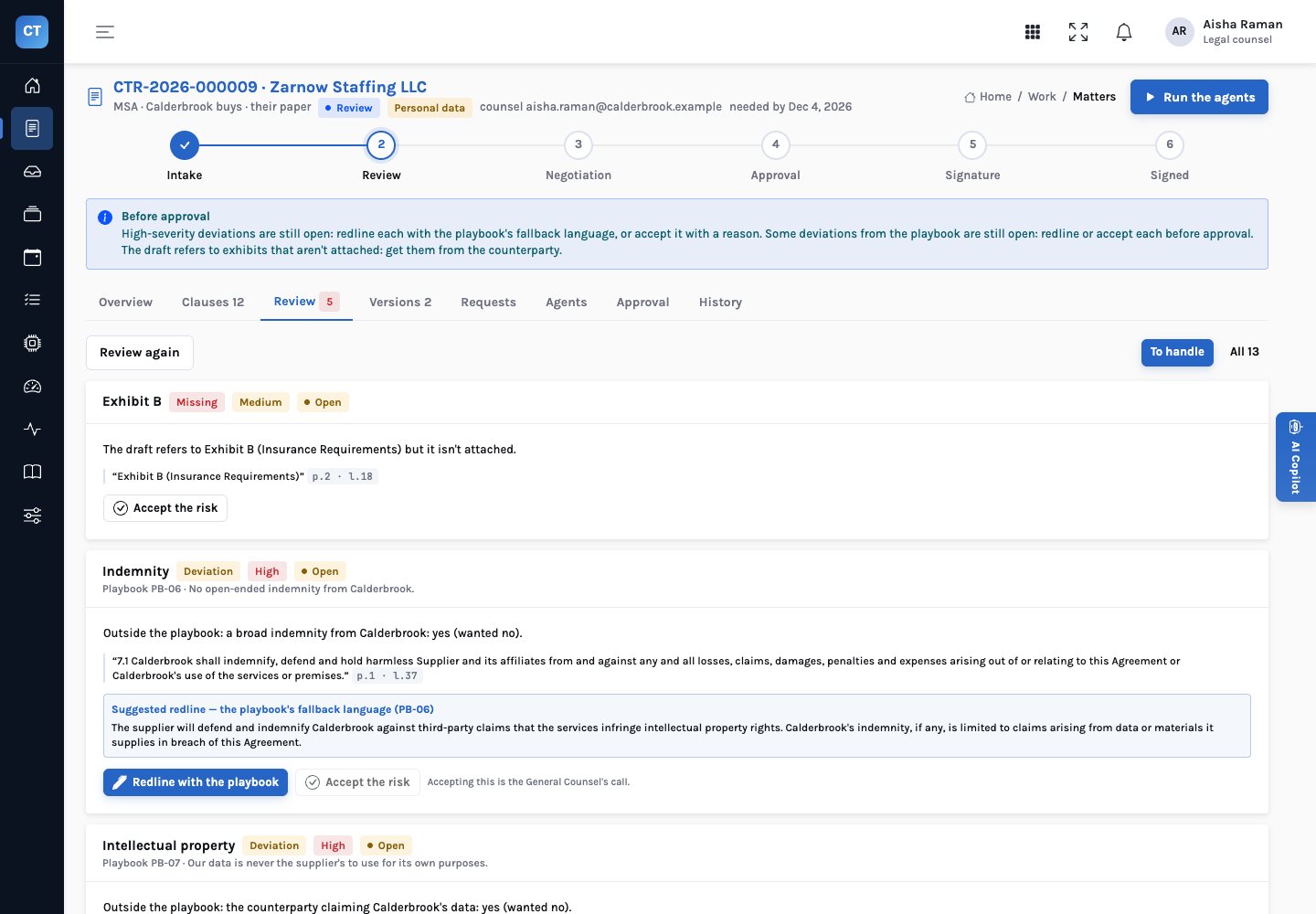
Zarnow Staffing’s master services agreement is a three-year deal worth US$1.545 million. On page 2, line 18, it refers to “Exhibit B (Insurance Requirements)”. The draft has an Exhibit C, the Data Processing Addendum, attached at the back. It has no Exhibit B. Whatever insurance Zarnow has agreed to carry is defined in a document nobody at Calderbrook has seen. Sign it as it stands and the obligation points at nothing.
In short
- A contract that incorporates a document you don’t have is incomplete. An exhibit referenced but never attached leaves its terms to be argued about later.
- The reader lists every exhibit the draft refers to and every exhibit it contains, each with page and line, and raises a finding for each one referenced and not attached.
- There is no redline for a missing document. The playbook has no fallback language for it; the answer is to ask for it. The intake agent drafts that request, and it waits for a person.
- A missing exhibit blocks approval under its own control, and the next review counts the exhibit as attached once the counterparty sends it through the request link.
The situation
This matter is on InsightContracts’ demo data: Calderbrook Systems, Inc. and Zarnow Staffing LLC
are fictional, and the playbook is illustrative, not legal advice. The matter is
CTR-2026-000009, from intake request REQ-0029: a master services agreement
(CB-MSA-0067) on Zarnow’s paper, Calderbrook buying, owned by the IT department,
with personal data declared.
| Exhibit | Referred to | Attached | Finding |
|---|---|---|---|
| Exhibit B (Insurance Requirements) | Page 2, line 18 | No | Missing, medium: blocks approval |
| Exhibit C (Data Processing Addendum) | Page 1, line 33 | Yes, page 3, line 2 | None: and because the DPA is attached, the data protection clause is within the playbook |
The second row matters as much as the first. Zarnow will process personal data for Calderbrook, and the draft’s section 6.1 says it will do so “in accordance with the Data Processing Addendum attached as Exhibit C”. Exhibit C is there, so the DPA check is satisfied and the data protection clause matches the preferred position. The reader doesn’t assume every reference is fine or every reference is broken; it checks each one.
Why this gets missed
- Exhibits arrive separately, or not at all. A counterparty sends the agreement as one file and the schedules as others, or promises them “to follow”. The review starts on what has arrived.
- The reference reads like boilerplate. “Supplier will maintain the insurance described in Exhibit B” sounds complete. The eye doesn’t stop to turn to the back.
- Exhibits are checked at signing, by someone else. When a signature package is assembled in a hurry, the missing exhibit is noticed, if at all, after every clause has been agreed and nobody wants to reopen the deal.
How InsightContracts finds it
When the clause reader reads a draft, it also reads the structure around the clauses: every “Exhibit A”, “Exhibit B” the text refers to, with its title where one is given, and every exhibit heading actually in the document. It also counts as attached any exhibit or DPA the counterparty has sent separately and that is filed on the matter. A letter in the first list and not in the second becomes a finding:
“The draft refers to Exhibit B (Insurance Requirements) but it isn't attached.” — quoted at page 2, line 18, severity medium.
Referenced against attached, one exhibit at a time.
Asking for it
The intake agent runs first on every matter and works out what is missing before the review can finish. On this matter it found one thing, and prepared a request to Zarnow for it:
| Prepared by | Title | What it asks for |
|---|---|---|
| Intake agent | Ask Zarnow Staffing LLC for 1 missing document | “Exhibit B — Insurance Requirements, referred to in the draft but not attached” |
That prepared decision is waiting on the counsel. If she accepts it, the request is drafted and held on the Requests tab, addressed to Zarnow’s contracts address, with the item listed and a due date seven days out. She can edit the wording. Only when she sends it does it get a link, and only then can Zarnow upload anything. In the demo the request is still a prepared decision; nothing has been sent to Zarnow.
Steps 3 to 5 are what would happen next. In the demo, the request is prepared and waiting on the counsel.
The rest of the draft
Exhibit B is the finding that blocks on its own control, but the draft has four playbook findings open as well, two of them high:
| Clause | Position | Severity | What the draft says |
|---|---|---|---|
| Indemnity (PB-06) | Deviation | High | “7.1 Calderbrook shall indemnify, defend and hold harmless Supplier and its affiliates from and against any and all losses, claims, damages, penalties and expenses arising out of or relating to this Agreement or Calderbrook's use of the services or premises.” (page 1, line 37) |
| Intellectual property (PB-07) | Deviation | High | The supplier claims “all data generated through Calderbrook's use of the services” (page 1, line 21) |
| Termination (PB-04) | Deviation | Medium | “9.1 Neither party may terminate this Agreement for convenience during the Initial Term.” (page 2, line 11) |
| Assignment (PB-14) | Deviation | Medium | The supplier may assign without consent (page 2, line 21) |
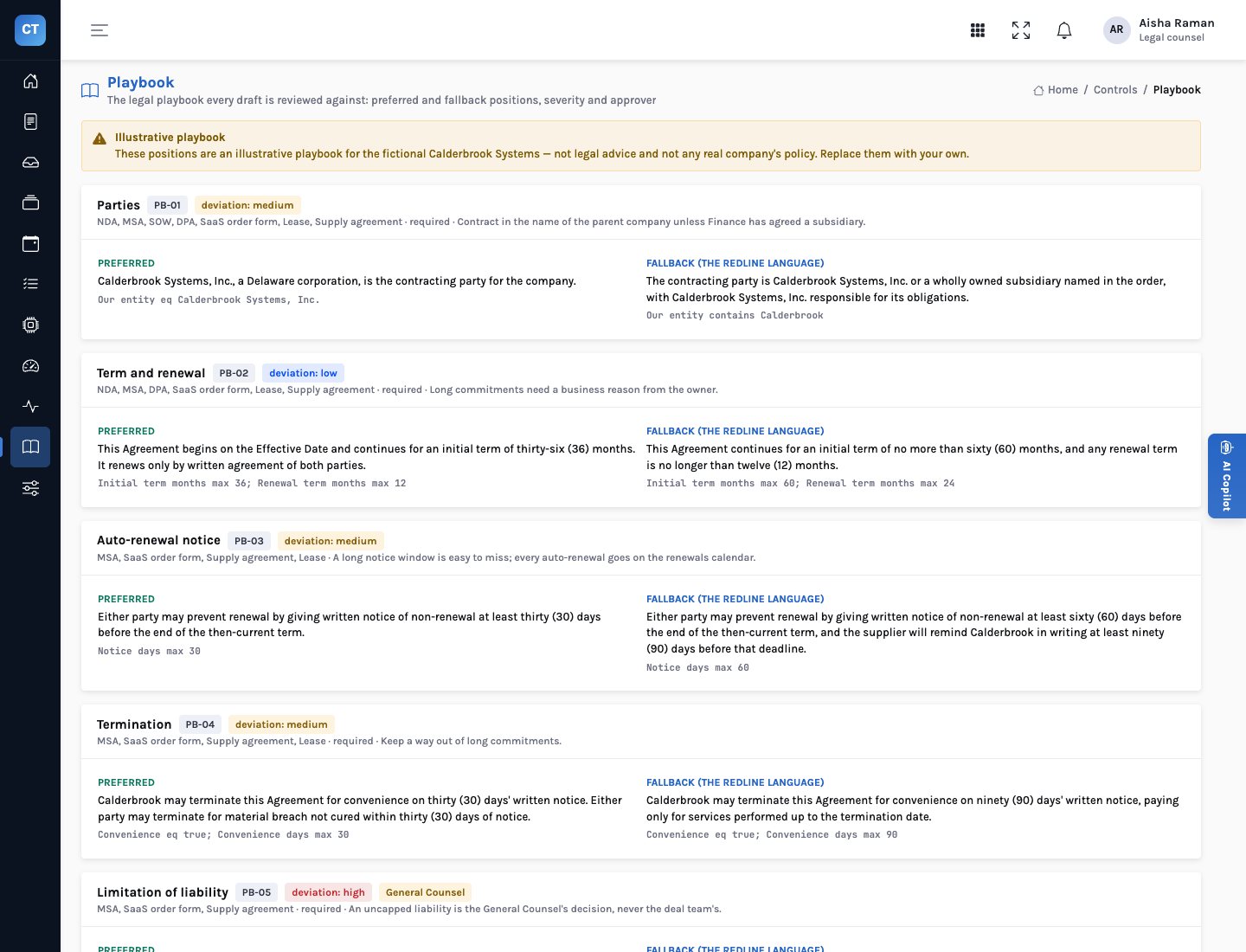
The redline drafter prepared four redlines, one for each, from the playbook’s fallback language
(PB-04, PB-06, PB-07, PB-14). It prepared none for
Exhibit B, because there is no language to propose for a document that hasn’t been sent. The
revised draft had already moved on liability: the three-month cap in the first draft became two times
the fees in twelve months, with three times for breach of the data protection section, which is within
the fallback position.
Who does what
MSA on the counterparty’s paper, personal data declared; one thing missing, Exhibit B. Prepares the request.
Twelve clauses from v2, every required clause found; exhibits B and C referred to, C attached.
Five findings open: Exhibit B, two high-severity deviations and two medium. Prepares the review summary.
Accepts the intake agent’s request, checks the message and sends it. The agent cannot send it.
Redlines the four deviations with the playbook’s language, or accepts with reasons. The two high-severity ones can be accepted only by the General Counsel.
When Exhibit B arrives through the link it is filed on the matter; the next review counts it as attached and the finding no longer applies.
The value is above the illustrative US$250,000 threshold. Once nothing blocks, the counsel submits and the General Counsel approves.
Accepting the risk instead
Exhibit B’s finding offers one alternative to asking: accept the risk. It is medium severity and the playbook doesn’t reserve it to the General Counsel, so a legal counsel can accept it, but only with a written reason, which goes on the decision record. There may be a good one: the insurance terms might be in a master agreement already signed, or the business might agree to drop the reference. What the product won’t do is let the gap pass silently.
The agreement is approved with a reference to Exhibit B. The exhibit arrives after signature, if at all, and its terms are whatever the counterparty sends.
The approval waits until the exhibit is on the matter, read like any other document, or until someone accepts its absence in writing.
What it means for each audience
For the General Counsel
What Calderbrook signs is what it has read. An agreement doesn’t reach approval while it incorporates a document nobody has seen, unless someone accepts that in writing.
Insurance requirements are where a supplier’s promise to cover a loss lives; they deserve the same review as the clauses that refer to them.
For legal operations
The check is mechanical and complete: every reference against every attachment, on every draft, with the request already drafted.
Counsel time goes on deciding whether to ask or accept, not on paging through schedules.
For the board
Signature packages are complete when they are approved, not assembled afterwards.
Fewer surprises when someone opens the contract a year later looking for Exhibit B.
What to be careful about
- The check reads exhibit references by letter. Schedules, annexes or appendices named differently, or documents incorporated by a web link, still need a lawyer’s eye.
- Attached isn’t reviewed. When Exhibit B arrives, InsightContracts reads it and files it. Whether the insurance limits in it are adequate is a judgement for the counsel and, often, the company’s risk or insurance team.
- A reference can be removed instead. If the parties agree the exhibit isn’t needed, the right fix is a draft without the reference, not an acceptance that leaves a dangling cross-reference in the signed contract.
A contract is everything it refers to.
Check every exhibit the draft names against every exhibit it contains, and ask for the missing one before anyone approves.