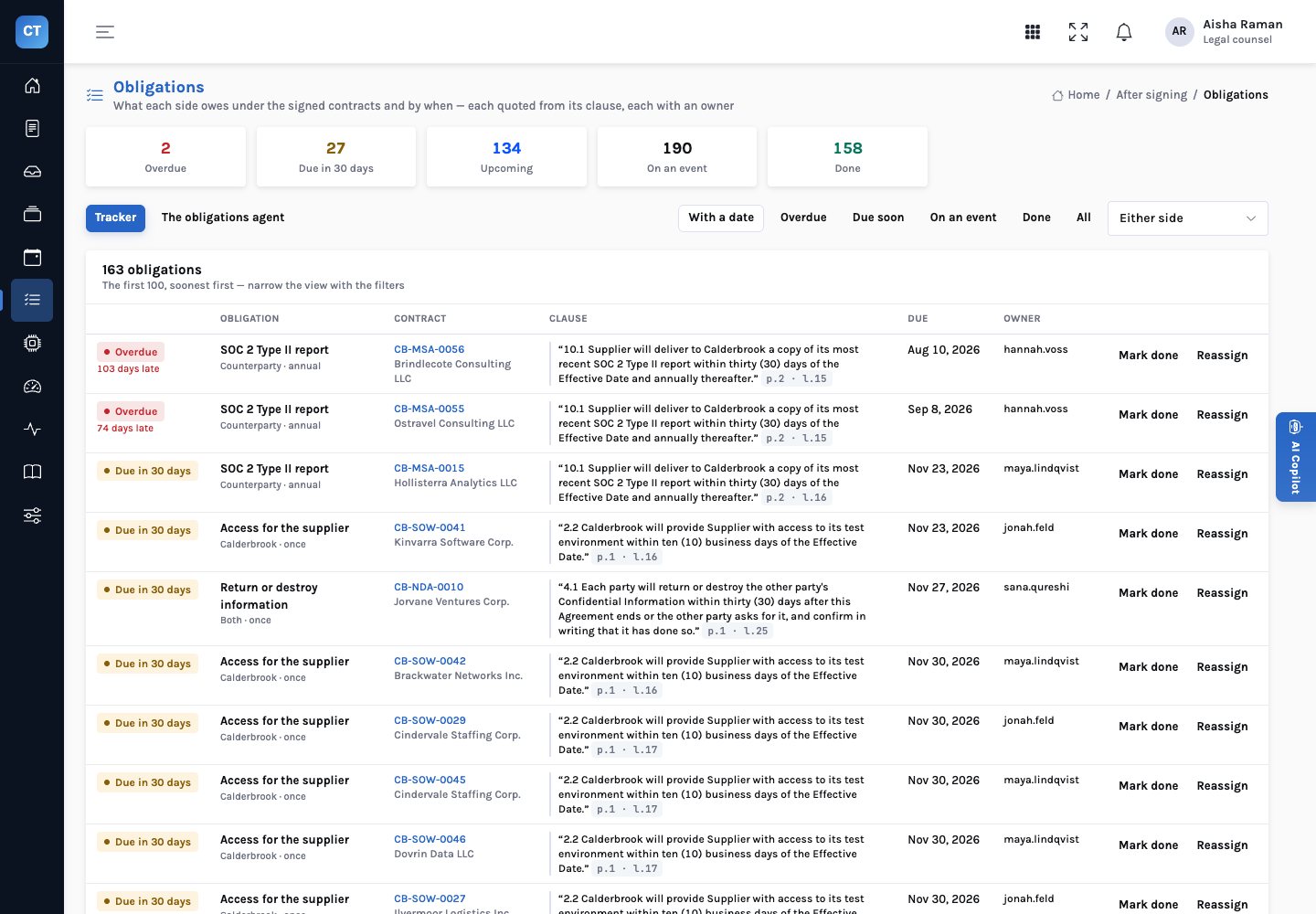
Brindlecote Consulting signed a master services agreement with Calderbrook in July 2026. Clause 10.1 says it will deliver its most recent SOC 2 Type II report within thirty days of the effective date and every year after. The thirty days ran out on 10 August. On the day of this demo the report is 103 days late, and nothing in the company’s systems said so, because once a contract is signed it is usually filed and forgotten. Meanwhile, a different supplier’s Amendment No. 2 is in force on the register but its signature block for the supplier is blank.
In short
- A signed contract is a list of promises. The tracker holds each one, quoted from its clause with page and line, with who owes it, when, and a named owner at the company.
- Two obligations are overdue, 27 fall due in 30 days. Both overdue items are suppliers’ SOC 2 Type II reports.
- Unsigned amendments are flagged from the document, not the register. A blank counterparty signature block on an amendment the register treats as effective is a high-severity flag.
- The obligations agent prepares the asks. Four requests (two reports, two countersignatures) are drafted and held; a person sends them.
The situation
On InsightContracts’ demo data (Calderbrook Systems, Inc., a fictional company), the obligations tracker is built from the executed copy of every signed contract in the repository. On 21 November 2026 it holds 511 obligations:
| Item | Contract | Quoted from | Due | State |
|---|---|---|---|---|
| SOC 2 Type II report from Brindlecote Consulting LLC | CB-MSA-0056 | “10.1 Supplier will deliver to Calderbrook a copy of its most recent SOC 2 Type II report within thirty (30) days of the Effective Date and annually thereafter.” (p.2, l.15) | 10 Aug 2026 | Overdue, 103 days |
| SOC 2 Type II report from Ostravel Consulting LLC | CB-MSA-0055 | The same clause 10.1 (p.2, l.15) | 8 Sep 2026 | Overdue, 74 days |
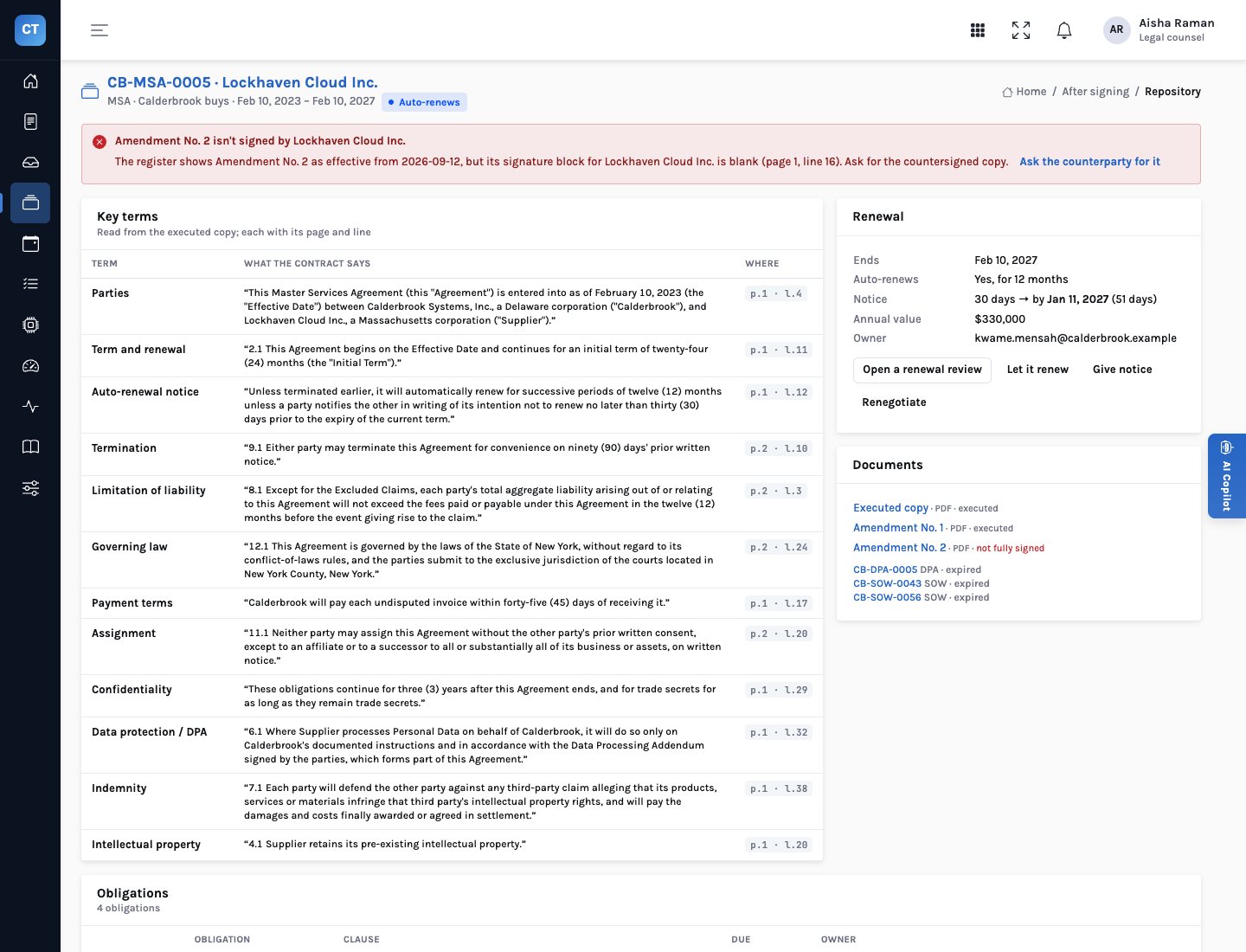
| Amendment No. 2, Lockhaven Cloud Inc. | CB-MSA-0005 | Signature block blank (p.1, l.16) | Effective per the register from 12 Sep 2026 | Not countersigned |
| Amendment No. 2, Quellford Cloud Inc. | CB-MSA-0001 | Signature block blank (p.1, l.16) | Effective per the register from 17 Oct 2026 | Not countersigned |
Both overdue reports have the same owner at Calderbrook, hannah.voss. Both suppliers delivered their certificates of insurance on time under clause 10.2, which the tracker shows as done with “Certificate on file.” It is the annual report that slipped.
Why obligations get missed
- They are buried in the clause. “Within thirty (30) days of the Effective Date and annually thereafter” is a schedule, but only if someone reads it as one.
- Nobody owns them. Legal negotiated the contract; the business uses the service; security wants the report. Without a named owner the report is everyone’s and no one’s.
- The counterparty’s promises feel like the counterparty’s problem. Until an auditor asks for the supplier’s SOC 2 report and nobody has it.
- Amendments are filed, not checked. An amendment goes on the register when it is agreed, sometimes before the other side has signed, and nobody looks at the signature page again.
A spreadsheet of key dates, built once at signing and maintained by whoever remembers. Amendments recorded as agreed.
Each obligation read from the signed contract with its quote, page and line, a due date worked out from the clause, an owner, and a state. Amendments checked for blank signature blocks.
How the tracker is built
When a signed contract joins the repository, the reader goes through it sentence by sentence for promises: a sentence with will, shall or must and a time limit (“within thirty (30) days”). It records who owes it (Calderbrook, the counterparty, or both), what kind of obligation it is, and what the time limit runs from: the effective date, the end of the contract, each calendar quarter, or an event. From that it works out the due dates.
| Recurrence | Example from the demo | How it is dated |
|---|---|---|
| Once | Certificate of insurance within fifteen days of the Effective Date | Effective date plus the period |
| Annual | SOC 2 Type II report within thirty days of the Effective Date and annually thereafter | The first due date, then each anniversary; the tracker shows the latest past one and the next |
| Quarterly | A service-level report after each calendar quarter | From the end of each quarter |
| On an event | Notice of a security incident within seventy-two hours of becoming aware of it | No date until it happens; shown as standing |
Payment terms aren’t tracked as obligations, since they run per invoice. Where the business has already recorded an obligation as met, the tracker shows it done with that note. The SOC 2 date for Brindlecote follows from the dates on the contract: the insurance certificate, due fifteen days after the effective date, was due 26 July; the report, due thirty days after, was due 10 August.
From the clause to a dated, owned line in the tracker.
The amendment nobody countersigned
The second problem is quieter. Calderbrook’s register says Amendment No. 2 to the Lockhaven Cloud MSA has been effective since 12 September 2026. When the repository read the amendment’s document, the signature block for Lockhaven Cloud Inc. on page 1, line 16 was blank: “By: ______________________________ | Name: | Title: | Date:”. The contract carries a high-severity flag at the top of its page, with a link to ask the counterparty for the countersigned copy. The same is true of Amendment No. 2 to the Quellford Cloud MSA, effective on the register from 17 October 2026.
Why it matters
Whether a partly signed amendment binds anyone depends on the facts and the governing law, and is a question for your counsel. What isn’t in doubt is that the company’s file is incomplete, and that the easiest time to fix it is now, not during a dispute.
What the obligations agent prepared
The obligations agent runs over the repository with the renewals agent. Its headline on the demo: “2 obligations overdue, 27 due in 30 days; 2 amendments not countersigned.” It prepared four decisions, one per counterparty and item:
| Prepared decision | What accepting does |
|---|---|
| Ask Brindlecote Consulting LLC for 1 overdue item under CB-MSA-0056 | Drafts a request for the SOC 2 Type II report, quoting clause 10.1, held on the contract |
| Ask Ostravel Consulting LLC for 1 overdue item under CB-MSA-0055 | The same, for Ostravel’s report |
| Ask Lockhaven Cloud Inc. to countersign Amendment No. 2 (CB-MSA-0005) | Drafts a request for the countersigned copy, held |
| Ask Quellford Cloud Inc. to countersign Amendment No. 2 (CB-MSA-0001) | The same, for Quellford |
Accepting drafts the request and holds it; the product’s own message says so: “nothing reached the counterparty.” A person reads it and sends it. The counterparty answers through a no-login link, and what it uploads is filed on the contract as evidence. The owner then marks the obligation done, with a note that becomes part of the record.
The agent spots it and drafts the ask; the owner sends it and closes it.
Who does what
Quoted with page and line; who owes it; due dates from the clause.
Defaults to the contract owner; reassign to whoever actually receives the report.
Prepares one ask per counterparty and item.
The request is held until sent. An agent can’t send.
“Report received and filed”: the note is the evidence on the record.
A supplier that won’t provide a contracted security report is a commercial and legal question.
A connection worth noticing
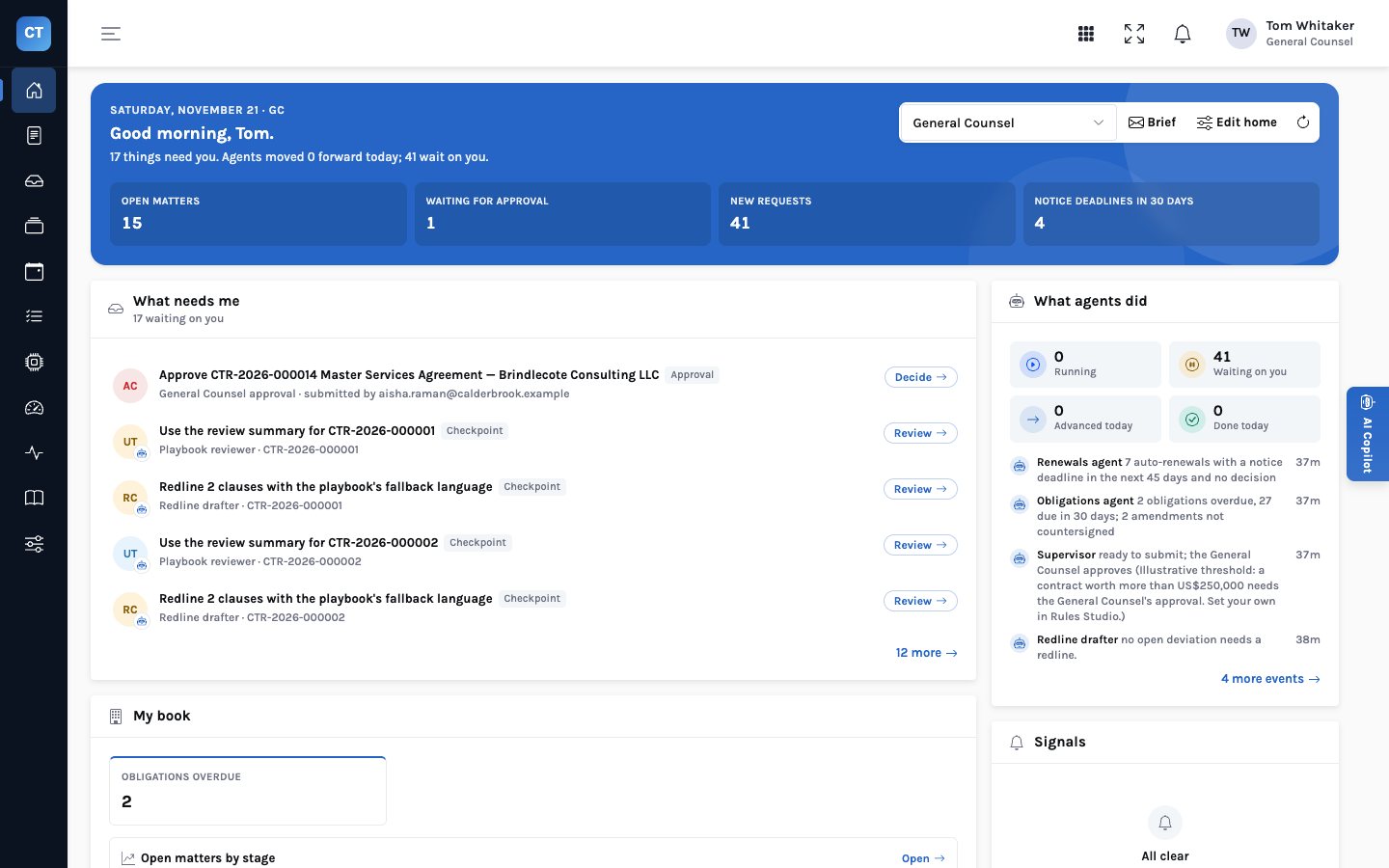
Brindlecote Consulting, whose SOC 2 report is overdue under CB-MSA-0056, is also the counterparty
on CTR-2026-000014, a new US$1.22 million master services agreement waiting for the General
Counsel’s approval. The two facts sit in different parts of the product; the copilot has read-only tools
over both the matter and the obligations tracker, so with a language model configured a question on the matter
can bring them together. (With the model off, as in the demo, it answers with the matter’s headline facts.) Whether an overdue report
under one contract should hold up another is a judgement for the people involved. Seeing both is the point.
What it means for each audience
For the General Counsel
The company’s rights under its contracts are only worth what it enforces. Overdue reports and unsigned amendments become a short list with owners, not a discovery in a dispute.
Every closed item carries a note and a name.
For legal operations
The tracker is built from the signed documents, so it doesn’t depend on someone keying dates in at signing. Owners can be reassigned in one step.
The agent drafts the chasers.
For the board
Third-party risk questions (“do we have every critical supplier’s SOC 2 report?”) have a current answer.
So does “are our amendments signed?”
What to be careful about
- The reader finds promises with a time limit. Obligations written without one (“Supplier will maintain insurance”) need a person to add them or to accept that they are standing duties.
- Done means evidence. Mark an obligation done when the report is on file, not when it is promised.
- The demo’s data is invented. Calderbrook and every counterparty are fictional; the counts above describe the demo, not any real company.
Signing is the start of a contract’s obligations, not the end of legal’s interest in it.
Read every promise from the signed copy, give it an owner and a date, and let the agent draft the reminder before an auditor asks.