Calderbrook’s IT team subscribes to a piece of software from Orlenby Software. The order form runs until 26 February 2027. That date is not the one that matters. The order form renews for another twelve months unless notice is given ninety days before it ends, so the last day anyone can stop the renewal is 28 November 2026: a week from the day of this demo. Miss it and the decision is made by default.
In short
- The deadline is the notice date. End of the current term less the notice period, both read from the executed copy, with the clause quoted at its page and line.
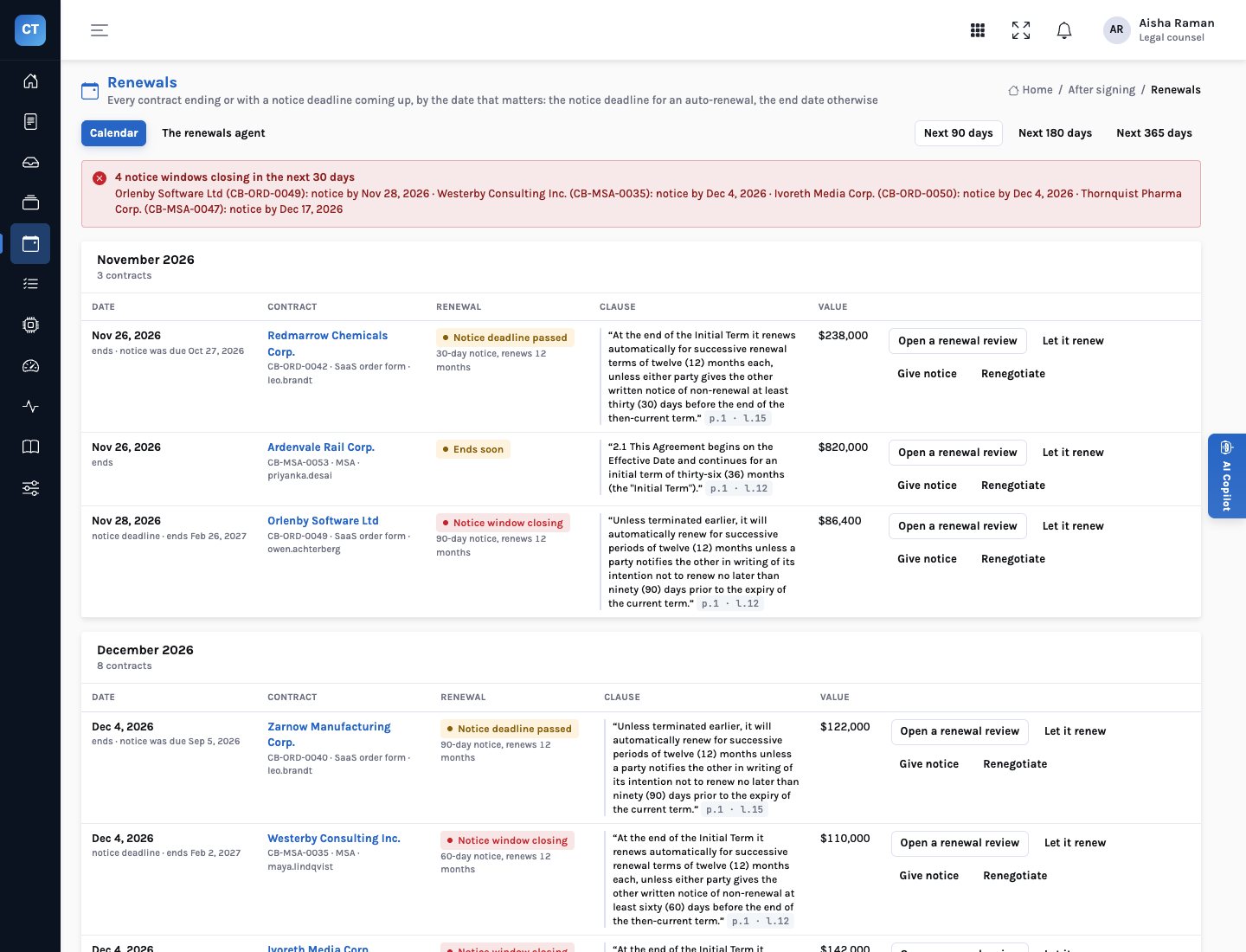
- Four windows close in the next thirty days, five have already passed. The renewals calendar shows both, sorted by the date that matters.
- The renewals agent prepares, the owner decides. Seven renewal decisions are prepared for deadlines inside forty-five days. Renew, give notice or renegotiate is a person’s choice.
- InsightContracts doesn’t send the notice. Deciding to terminate records the decision and its reason; the owner sends the notice of non-renewal.
The situation
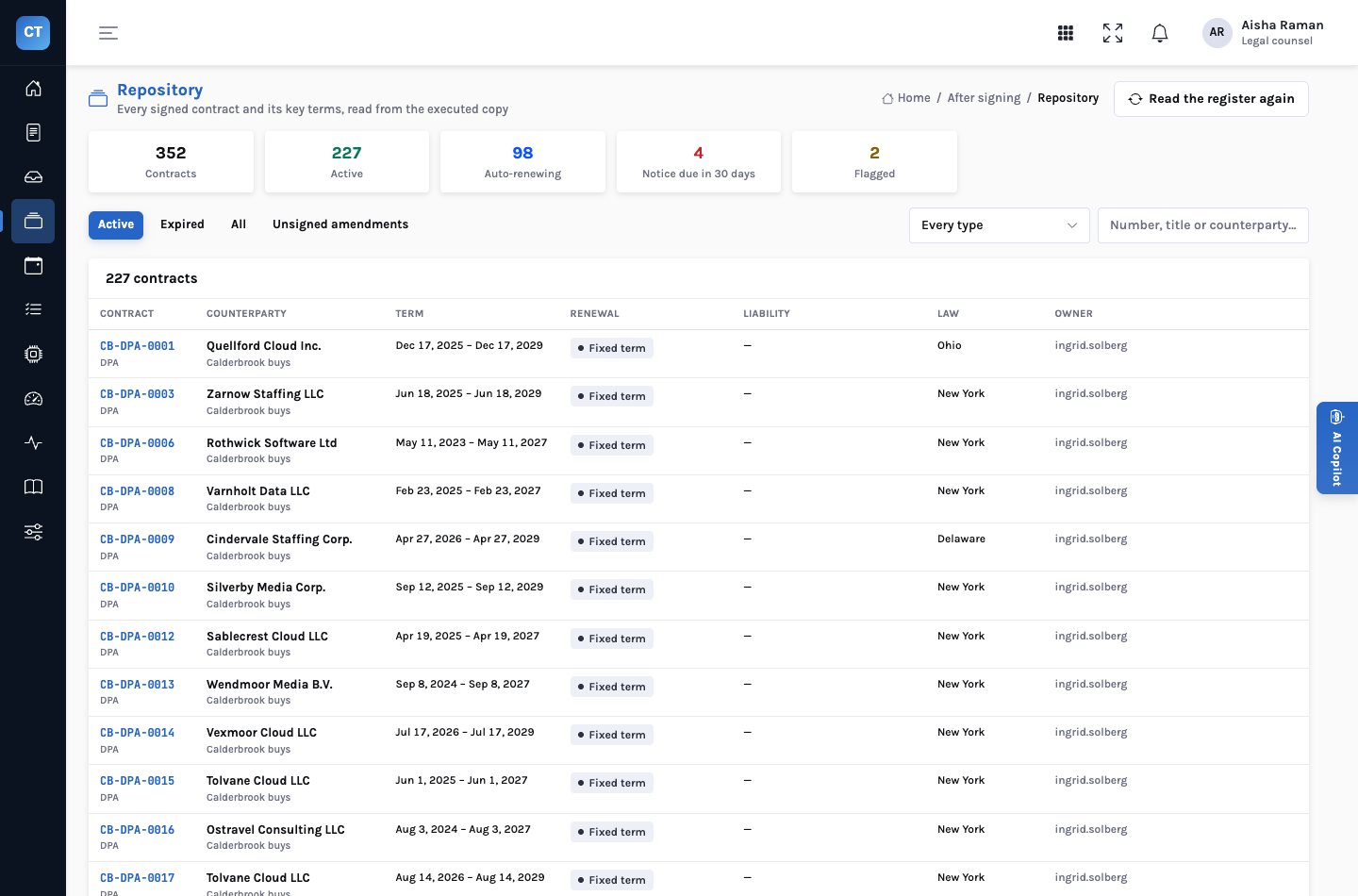
The renewals calendar on InsightContracts’ demo data (Calderbrook Systems, Inc., a fictional company) reads every signed contract’s term, renewal and notice clauses from its executed copy. On 21 November 2026, nine auto-renewing contracts sit at or past the line:
| Contract | Ends | Notice | Notice deadline | Status |
|---|---|---|---|---|
SaaS Order Form, Orlenby Software Ltd (CB-ORD-0049) | 26 Feb 2027 | 90 days | 28 Nov 2026 (7 days) | Notice window closing |
MSA, Westerby Consulting Inc. (CB-MSA-0035) | 2 Feb 2027 | 60 days | 4 Dec 2026 (13 days) | Notice window closing |
SaaS Order Form, Ivoreth Media Corp. (CB-ORD-0050) | 4 Mar 2027 | 90 days | 4 Dec 2026 (13 days) | Notice window closing |
MSA, Thornquist Pharma Corp. (CB-MSA-0047) | 16 Jan 2027 | 30 days | 17 Dec 2026 (26 days) | Notice window closing |
Supply Agreement, Ulverby Circuits Inc. (CB-SUP-0031) | 16 Jan 2027 | 60 days | 17 Nov 2026 (4 days ago) | Notice deadline passed |
SaaS Order Form, Redmarrow Chemicals Corp. (CB-ORD-0042) | 26 Nov 2026 | 30 days | 27 Oct 2026 | Notice deadline passed |
SaaS Order Form, Varnholt Networks B.V. (CB-ORD-0021) | 22 Jan 2027 | 90 days | 24 Oct 2026 | Notice deadline passed |
SaaS Order Form, Ardenvale Rail Corp. (CB-ORD-0046) | 9 Dec 2026 | 60 days | 10 Oct 2026 | Notice deadline passed |
SaaS Order Form, Zarnow Manufacturing Corp. (CB-ORD-0040) | 4 Dec 2026 | 90 days | 5 Sep 2026 | Notice deadline passed |
Every one of these renews for twelve months. Note the spread of notice periods: thirty, sixty and ninety days. The Thornquist agreement ends before the Orlenby order form, yet its deadline is three weeks later. Sorting by end date puts them in the wrong order.
Why renewals get missed
- The calendar holds end dates. Most contract registers record when a contract ends. The deadline that matters is earlier, by a notice period that differs contract to contract.
- The notice period is in the clause, not the register. Someone has to read it, and a later amendment can change it.
- The owner isn’t legal. The person who knows whether the software is still needed sits in IT or marketing, and doesn’t know the date is coming.
- Silence is a decision. An auto-renewal needs no action to happen. Not deciding is deciding to renew.
A reminder fires thirty days before the end date. For a ninety-day notice period that is two months too late.
The deadline is end date minus notice period, read from the signed contract with the clause quoted. The calendar and the agent work from that date.
How the deadline is worked out
When a signed contract enters the repository, InsightContracts reads its executed copy with the same clause reader it uses on drafts. From the term and renewal clause it takes the initial term, whether the contract renews automatically, the renewal term and the notice period. The notice deadline is the end of the current term less the notice period. For Orlenby:
The clause, from page 1, line 12 of the executed copy
“Unless terminated earlier, it will automatically renew for successive periods of twelve (12) months unless a party notifies the other in writing of its intention not to renew no later than ninety (90) days prior to the expiry of the current term.” The current term ends on 26 February 2027; ninety days before is 28 November 2026.
The deadline sits ninety days before the end of the term, and a week after today.
A contract that auto-renews and whose deadline has passed has, in effect, renewed; the calendar marks it “notice deadline passed”, and once the new term starts the deadline moves to the new term’s end less the notice period.
What the renewals agent prepared
The renewals agent runs over the repository and looks for auto-renewals whose notice deadline falls in the next forty-five days and on which nobody has decided. On the demo it found seven and prepared a decision for each, addressed to the contract’s owner. The Orlenby one reads:
Decide the renewal of SaaS Order Form — Orlenby Software Ltd — notice due 2026-11-28
Ends 2027-02-26; renews automatically for 12 months unless notice is given at least 90 days before. Notice deadline: 2026-11-28 (7 days from today). Followed by the quoted clause, page 1, line 12.
The agent is capped at L2 and, in the demo, sits at L1: it prepares, and a person acts. Accepting the prepared decision opens a renewal review, a matter where the counsel and the owner look at the terms before the window shuts. It doesn’t renew, terminate or notify anyone.
The agent finds and prepares. The decision, and the notice itself, are people’s.
The owner’s choices
| Decision | What InsightContracts records | What a person still does |
|---|---|---|
| Let it renew | The decision, who took it and when; the status changes from “notice window closing” | Nothing more; the contract renews on its terms |
| Give notice | The decision and its reason (a reason is required) | Sends the notice of non-renewal in the form the clause requires. InsightContracts doesn’t send it |
| Renegotiate | The decision; a renewal review can be opened as a matter | Negotiates, ideally before the deadline so notice remains an option |
| Open a renewal review | A matter for the renewal, linked to the contract | Reviews the terms against today’s playbook |
Who does what
Term, renewal and notice read from the signed contract, each with page and line.
End of the current term less the notice period.
For every undecided auto-renewal with a deadline in the next 45 days.
Renew, give notice with a reason, or renegotiate.
In writing, as the clause requires, before the deadline.
File the notice and any acknowledgement on the contract.
The ones that already passed
Five contracts in the table above passed their notice deadline with no decision recorded. For the Ulverby Circuits supply agreement, the deadline was four days ago. Read the list with care: on three of the five (Zarnow Manufacturing, Ardenvale Rail, Redmarrow Chemicals) Calderbrook is the seller, and a renewal is revenue rather than spend. The calendar shows both sides; whether a passed deadline is a problem depends on which side you are on. Where Calderbrook is buying, the honest options are the renewal on its terms, or a conversation with the supplier, which is a commercial question rather than a right under the clause.
A note on the law
Some jurisdictions regulate automatic renewal clauses, mostly for consumer contracts but in some places for business contracts too (New York’s General Obligations Law § 5-903, for example, addresses automatic renewal of certain service contracts and requires the provider to send a reminder). Whether any such rule applies to a given contract, and what it requires, is a question for your counsel. InsightContracts reads what the contract says; it doesn’t decide what the law makes of it.
What it means for each audience
For the General Counsel
Renewals stop being decided by default. Every undecided deadline inside forty-five days has a prepared decision waiting on a named owner.
The clause is quoted, so nobody argues about what it says.
For legal operations
The calendar sorts by the date that matters and shows the notice period on every row. The agent’s list is the week’s agenda.
Decisions are recorded with who took them.
For the board
Spend that renews silently is spend nobody chose. The number of deadlines passed without a decision is a simple measure of control.
It should trend to zero.
Metrics to track
What to be careful about
- Count days the way the contract does. “No later than ninety days prior to the expiry” and “at least ninety days before the end” can differ by a day depending on how the clause and the governing law count. Treat the computed deadline as the latest safe date only after your counsel has agreed the convention; give notice early.
- Amendments can move the dates. If an amendment changes the term or the notice period, make sure the executed amendment is on file, and watch for amendments that aren’t fully signed.
- The notice is a legal act. Send it in the form and to the address the contract’s notices clause requires, and keep proof of delivery.
The end date is when the contract stops. The notice date is when you can still decide.
Read the deadline from the signed contract, put it in front of the person who owns the decision, and record what they chose.